Bounce
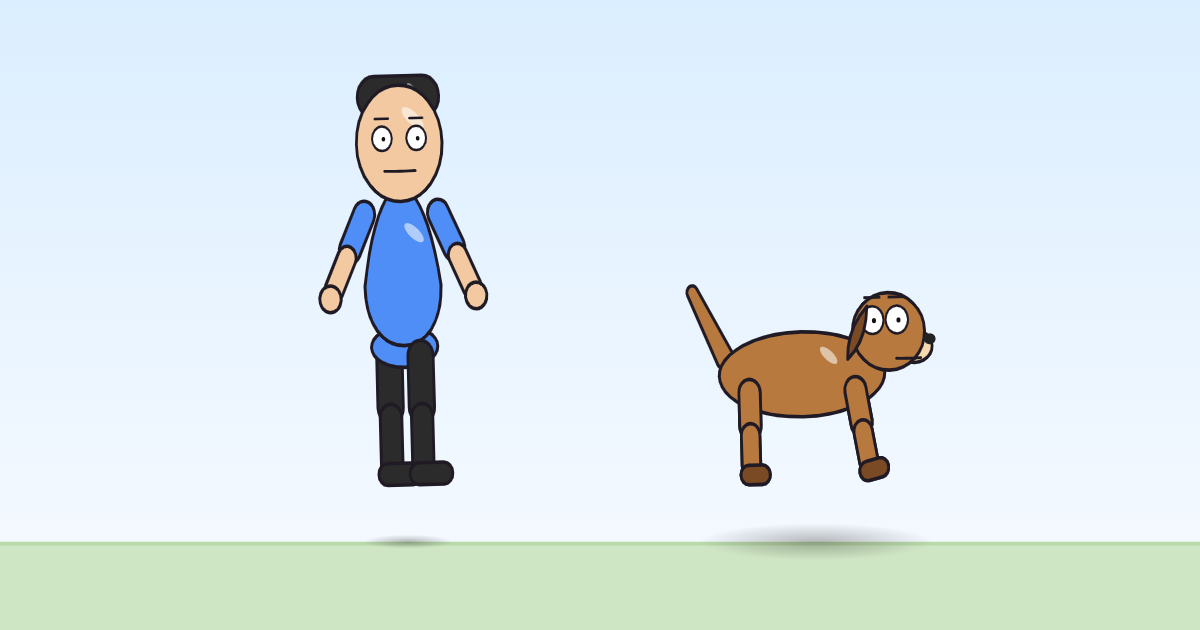
High, springy jumps on the spot, the arms lifting out as the character reaches the top. It reads as pure, noisy excitement.
Use it in a cartoonOpen it in the block editorThe pack file (JSON)
What it is for
Bounce is for a character who cannot stand still: a child who has been told the trip is on, a pet who sees the lead, a crowd at a goal. It fills the space above the character, so give it room. Under a short shout ("Yes!", "We won!") it does a lot of the acting for you, and on a background character it makes a scene feel busy and happy without a word.
The principle it shows: secondary action
The main action is the jump. The arms are a second, smaller action that rides on top of it: they are tied to the height of the jump, so they hang near the sides on the ground and lift out by another 20 degrees at the top. A secondary action should support the main one, never fight it, which is exactly what goes wrong in the second edit below.
The program, line by line
when it starts
  hop 95 · 1.7 per second
  sin wave on rot · w (0.9*pi) · amp 3
  left arm follows (-(8 + hopair(mod(tau*1.7, 1))*20))
  right arm follows (8 + hopair(mod(tau*1.7, 1))*20)
when it starts— begins when the move is put on a character.hop 95 · 1.7 per second— the hop block, 95 pixels high, 1.7 times a second (one jump every 0.59 seconds), with its own crouch, stretch and landing squash.sin wave on rot · w (0.9*pi) · amp 3— a slow rock of 3 degrees each way. 0.9 × π radians per second is one full rock every 2.2 seconds.left arm follows (-(8 + hopair(mod(tau*1.7, 1))*20))— the left arm is driven by a formula, worked out on every frame.tauis the time since the move began;tau*1.7counts jumps;mod(…, 1)keeps only the part of the current jump that has passed;hopairturns that into the jump's height, 0 on the ground and 1 at the top. So the arm sits 8 degrees out and swings to 28 degrees out at the top. The minus sign is there because a left arm turns outward the other way.right arm follows (8 + hopair(mod(tau*1.7, 1))*20)— the same for the right arm, without the minus.
Try this
Raise the jump from 95 to 150. The character now leaves the bottom of a small frame, so this works best when it stands well inside the picture.
In the program:
hop · amp95→150Slow the jumps to once a second. Watch the arms: their formula still counts 1.7 jumps a second, so they now flick out at the wrong moments. Change both 1.7s in the arm lines to 1 and they fall back in step with the feet.
In the program:
hop · hz1.7→1
How it differs from Hop and Jump for joy
Hop is the same hop block at about half the height and a little faster, with the arms left alone. Jump for joy is built from separate blocks instead of the hop block: a crouch, a 150-pixel leap with the arms thrown all the way up, a landing squish and a rest before the next leap. Bounce sits between them: continuous, like Hop, but big and loud, like Jump for joy.
Works on
| Body | Moves? | What moves |
|---|---|---|
| 2 legs (a person) | yes | whole body, arms |
| 4 legs (a dog) | yes | whole body, front legs |
| no legs (the monster with no legs) | yes | whole body, arms |