Pace
Short, tired steps while the character drifts slowly to one side and back: someone worrying, or waiting for news.
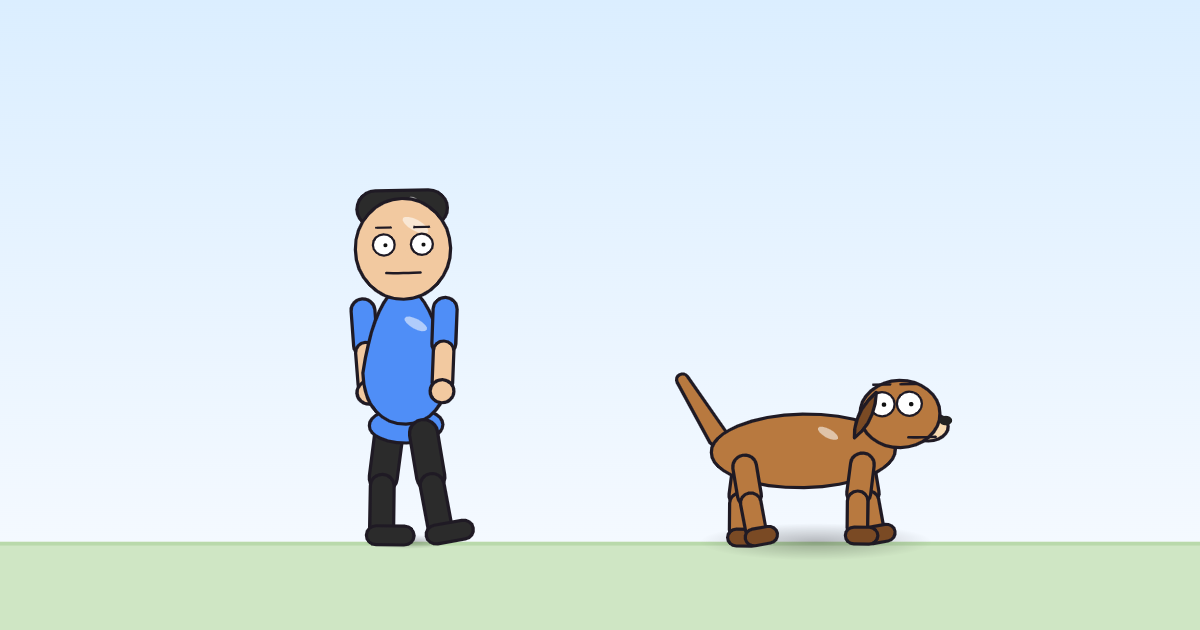
Use it in a cartoonOpen it in the block editorThe pack file (JSON)
What it is for
Pace is for worry and waiting: outside a classroom during an exam, by the window before a visitor arrives, in front of a door that will not open. It is slow on purpose. Note how long its back-and-forth takes: about 14 seconds. In a short slot, such as the 4 seconds this page plays it for, you see the character walk a little way to one side; in a long scene you see it come back. Use the first edit below if you want the whole pacing in a few seconds.
The principle it shows: timing
Pace and Walk back and forth both walk to and fro, but the feeling is completely different, and the difference is timing. Pace takes small, slow steps and drifts gently, with the body slightly lowered; the other walks briskly at a steady speed and turns sharply at each end. Slow, smooth timing reads as weary or thoughtful; brisk, even timing reads as purposeful.
The program, line by line
when it starts
  sin wave on dx · w 0.45 · amp 170
  walk cycle every 0.78 s · thigh × 0.8 · shin × 0.7 · arm swing 0.3 · bob 6/2 · roll 0
  set sy 0.97
  sin wave on rot · w 0.45 · amp 2
when it starts— begins when the move is put on a character.sin wave on dx · w 0.45 · amp 170— the drift: up to 170 pixels to one side and back, as a smooth wave. 2π ÷ 0.45 is about 14 seconds for a full trip there and back on both sides.walk cycle every 0.78 s · thigh × 0.8 · shin × 0.7 · arm swing 0.3 · bob 6/2 · roll 0— the walk block: one stride every 0.78 seconds, with smaller leg swings than the normal walk (80% at the thigh, 70% at the shin), a small arm swing, andbob 6/2: the body is held 6 pixels low and bobs up to 2 pixels with each step.roll 0means no side-to-side roll.set sy 0.97— the height held at 97%: a slight slump.sin wave on rot · w 0.45 · amp 2— a 2-degree lean that follows the drift.
The walk block steps every leg the body has (two, four, or none on the monster without legs) and swings the arms against the legs.
Try this
Speed up the drift from 0.45 to 1.5. The character now walks out and back about every 4 seconds instead of every 14, so a short scene shows the whole pacing.
In the program:
wave · w0.45→1.5Make each stride take 1.2 seconds instead of 0.78. The steps get heavy and slow, as if the character were exhausted.
In the program:
gait · every0.78→1.2
How it differs from Walk back and forth and Walk in
Walk back and forth covers 420 pixels at a steady speed and flips round at each end. Walk in is a single entrance from the side that ends in a stop. Pace never really arrives anywhere.
Works on
| Body | Moves? | What moves |
|---|---|---|
| 2 legs (a person) | yes | whole body, arms, legs |
| 4 legs (a dog) | yes | whole body, front legs, back legs |
| no legs (the monster with no legs) | yes | whole body |