Bow
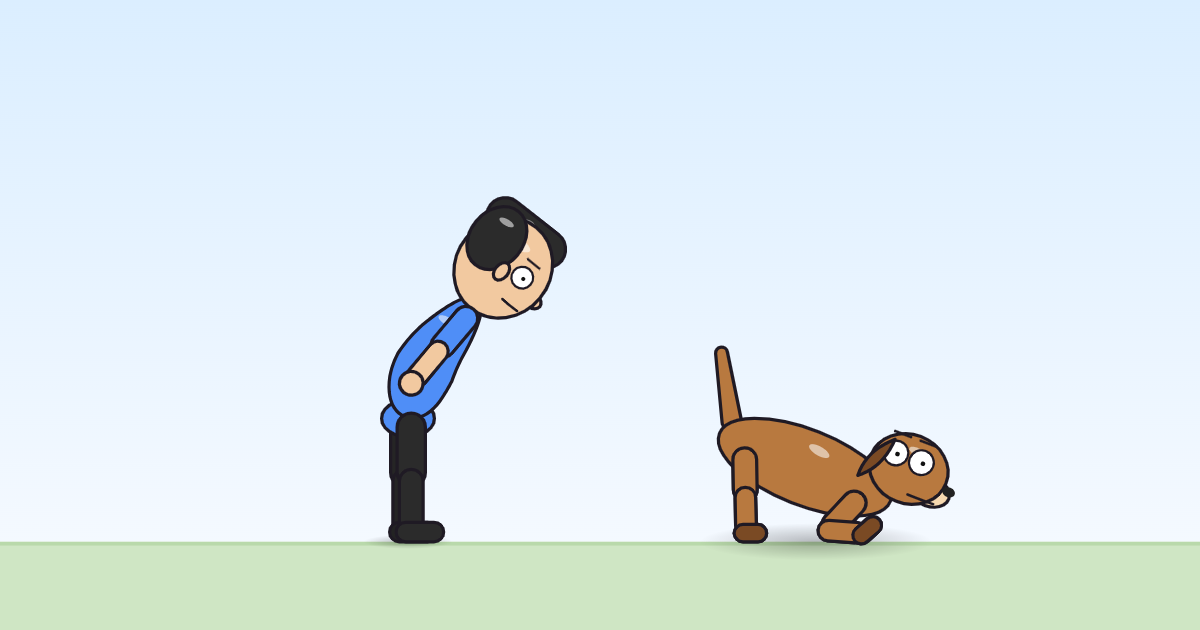
A polite bow from the side: the character turns side-on, bends forward and back up while its head, hair and ears lag behind the spine, then turns to face you again.
Use it in a cartoonOpen it in the block editorThe pack file (JSON)
What it is for
Bow ends a performance, greets a king, thanks the audience or apologises. It takes about 2.7 seconds from start to finish: a quarter of a second to turn side-on, the bow down, a pause at the bottom, the way back up and the turn back to the front. A dog or a cat bows as animals do in play, chest down and rear up with its feet planted. The bird has no side view, so it bows toward you with a nod and sweeps its wings out.
The principle it shows: follow-through and overlapping action
When the spine bends, the head, the hair and the ears do not move rigidly with it. Each is attached by a "let the … follow the body" block, which makes it behave like a spring: it lags a moment behind the body and catches up, swinging slightly past before it settles. That lag is follow-through, and because three parts lag by different amounts, they overlap. The bend itself eases in and out, so the bow starts and stops gently.
The program, line by line
when it starts
  turn to the side in 0.24 s
  let the head follow the body × 0.6
  let the hair follow the body × 1
  let the ears follow the body × 1
  wait 0.3 s
  bow 40° in 0.6 s
  wait 0.8 s
  bow 0° in 0.5 s
  turn to the front in 0.24 s
when it starts— this move uses the skeleton's blocks (the bones, views and springs every Jabbertoon character has).turn to the side in 0.24 s— the character turns to its side view. The turn squashes the body to nothing and opens it out again side-on, so it looks like a turn rather than a cut.let the head follow the body × 0.6,let the hair follow the body × 1,let the ears follow the body × 1— three springs: these parts now lag behind every bend, bounce and tilt of the body, the head a little and the hair and ears fully.wait 0.3 s— a beat before the bow.bow 40° in 0.6 s— the spine bends 40 degrees forward, shared between its two segments (waist and chest), easing in and out.wait 0.8 s— hold at the bottom.bow 0° in 0.5 s— straighten up.turn to the front in 0.24 s— turn back to face the viewer.
Try this
Bow 70 degrees instead of 40. The person folds almost in half, a deep stage bow. A dog's or a cat's body tips only as far as its planted legs allow, so the animals deepen their play bow a little rather than folding.
In the program:
bow · deg40→70Let the head follow the body 2 times as much instead of 0.6. The head now lags well behind as the spine bends and swings past when it stops, which looks floppy and comic.
In the program:
letFollow · amount0.6→2
How it differs from Look around and Hands on hips
Look around also changes view, but only turns, from side to side to front to back, with no bend. Hands on hips uses the skeleton's reach block instead of its bend. Bow is the move that shows the spine bending, and the springs that follow it.
Works on
| Body | Moves? | What moves |
|---|---|---|
| 2 legs (a person) | yes | turns, body, head, arms |
| 4 legs (a dog) | yes | turns, body, head, front legs, tail, ears |
| no legs (the monster with no legs) | yes | turns, body, arms, tail, ears |