Nod yes
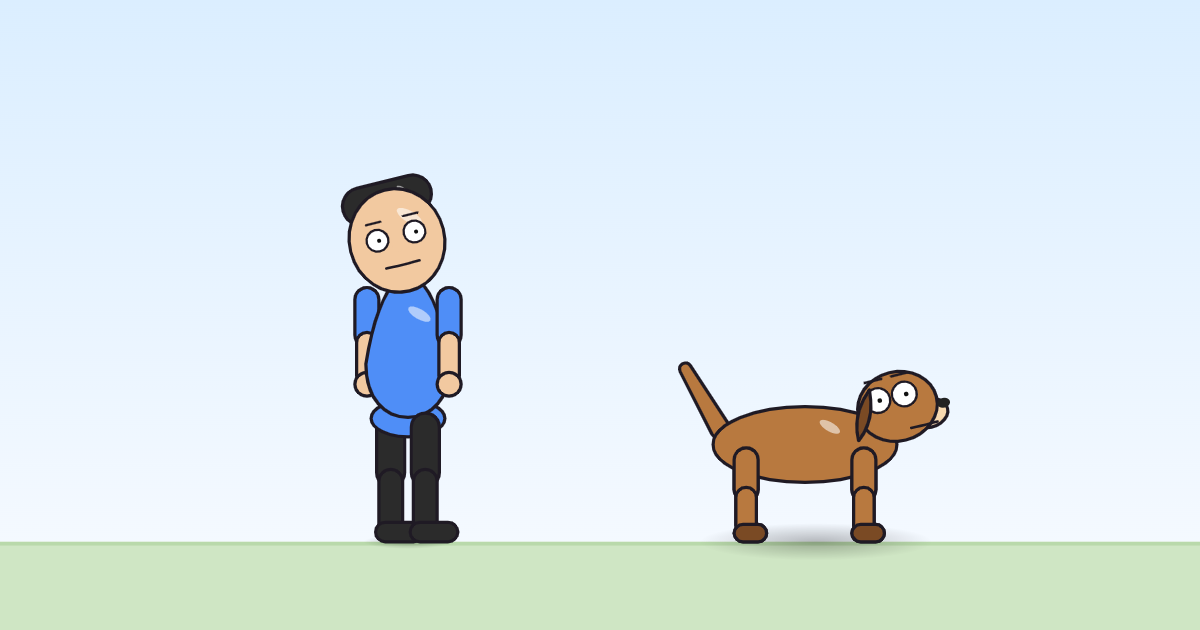
A quick, clear yes: the head dips and lifts twice, each dip slowing into the bottom and speeding back out.
Use it in a cartoonOpen it in the block editorThe pack file (JSON)
What it is for
Nod yes answers a question, agrees with a line, or confirms a plan, without a word. It is short, well under a second, so it sits inside a pause in dialogue without holding up the scene. Because it only moves the head, it works on every character, including the bird and the legless monster.
The principle it shows: slow in and slow out
Each dip eases into the bottom (fast at first, slowing as the head reaches 14 degrees) and eases out of it the other way (slow to start, picking up speed as it returns to level). Real heads do not move at a constant speed, and this pairing, slow at the bottom of the dip, faster coming back up, is what reads as a nod rather than a mechanical tick.
The program, line by line
when it starts
  repeat 2:
    glide head 14, head lift -4 over 0.15 s (out)
    glide head 0, head lift 0 over 0.15 s (in)
when it starts— begins when the move is put on a character.repeat 2:— the dip happens twice.glide head 14, head lift -4 over 0.15 s (out)— the head turns 14 degrees and drops 4 pixels, slowing into the bottom of the dip.glide head 0, head lift 0 over 0.15 s (in)— the head returns to level, speeding up as it goes, so the comeback feels quicker than the dip.
Try this
Nod 4 times instead of 2. The same two blocks, repeated twice as often, read as a more eager, emphatic yes.
In the program:
repeat · n2→4Dip the head 28 degrees instead of 14. The nod becomes a deep, deliberate bow of the head rather than a quick tic.
In the program:
ramp · to.part:head14→28
How it differs from Shake head no and Thumbs up
Shake head no turns the head side to side instead of down, the opposite answer in the same short, repeated shape. Thumbs up holds a single pose instead of repeating a dip, a different kind of silent answer.
Works on
| Body | Moves? | What moves |
|---|---|---|
| 2 legs (a person) | yes | head |
| 4 legs (a dog) | yes | head, ears |
| no legs (the monster with no legs) | yes | — |