Fall (four legs)
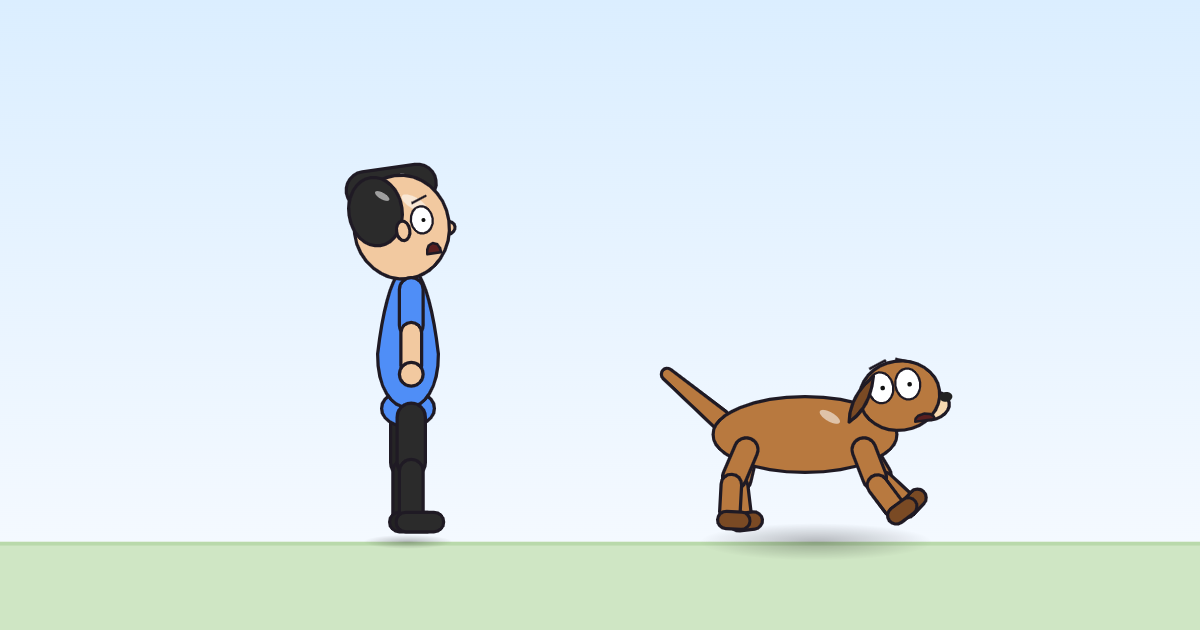
The fall of the game cycles for four legs: all four legs spread and paddle, the ears pin back and the tail whips, looping every 0.6 seconds for as long as a game has the character falling through the air.
Use it in a cartoonOpen it in the block editorThe pack file (JSON)
What it is for
Fall (four legs) is the fall of the nine game cycles, written for the fours set: the legs spread and paddling, the ears and tail up, rather than the upright set's arms-and-legs kick. It loops every 0.6 seconds for as long as the fall lasts, for as long as a game needs it.
The principle it shows: overlapping action
The back legs and the front legs each paddle on their own 0.6-second cycle, each pair opposite itself, while the tail whips at exactly twice that speed. Several limbs on slightly different rhythms, rather than one shared timing for the whole body, is what keeps the fall from reading as a single stiff flail.
The program, line by line
settings: h = 540, leg = 0.33
when it starts
  show the side view
  look scared
  set back left leg -18, back left shin 20, back left foot 0, back right leg -18, back right shin 20, back right foot 0, front left leg 26, front left shin 16, front left foot 0, front right leg 26, front right shin 16, front right foot 0, dy (-0.03*h), head 8, tail 30, ears -10, mouth 0.3
  sin wave on back left leg · every 0.6 s · amp 10
  sin wave on back right leg · every 0.6 s · amp 10 · phase 3.141592653589793
  sin wave on front left leg · every 0.6 s · amp 10
  sin wave on front right leg · every 0.6 s · amp 10 · phase 3.141592653589793
  sin wave on tail · every 0.3 s · amp 12
show the side view— the move is drawn in profile.look scared— the face changes to its scared expression for as long as the move plays.set back left leg -18, back left shin 20, back left foot 0, back right leg -18, back right shin 20, back right foot 0, front left leg 26, front left shin 16, front left foot 0, front right leg 26, front right shin 16, front right foot 0, dy (-0.03*h), head 8, tail 30, ears -10, mouth 0.3— the base falling pose: all four legs spread, the ears pinned back and the tail thrown up, the body lifted slightly to leave room for the paddling.sin wave on back left leg · every 0.6 s · amp 10,sin wave on back right leg · every 0.6 s · amp 10 · phase 3.14— the back legs paddle, opposite each other.sin wave on front left leg · every 0.6 s · amp 10,sin wave on front right leg · every 0.6 s · amp 10 · phase 3.14— the front legs paddle the same way.sin wave on tail · every 0.3 s · amp 12— the tail whips twice as fast as the legs.
Try this
Whip the tail every 0.15 seconds instead of 0.3. The fall reads as far more frantic, as if the character only just started falling.
In the program:
wave · every0.3→0.15Pin the ears back 25 degrees instead of 10. The character's whole posture reads as far more alarmed as it falls.
In the program:
set · to.part:ear-10→-25
How it differs from Jump (four legs, in place) and Fall
Jump (four legs, in place) has its own brief fall phase built into a fixed arc toward a landing; this Fall is the open-ended loop a game reaches for once the drop's length is not yet known. Fall is the same idea for the upright set, kicking with two legs rather than paddling with four.
Works on
| Body | Moves? | What moves |
|---|---|---|
| 2 legs (a person) | yes | whole body, turns, head |
| 4 legs (a dog) | yes | whole body, head, front legs, back legs, tail |
| no legs (the monster with no legs) | yes | whole body, turns, tail, ears |