Floppy hop
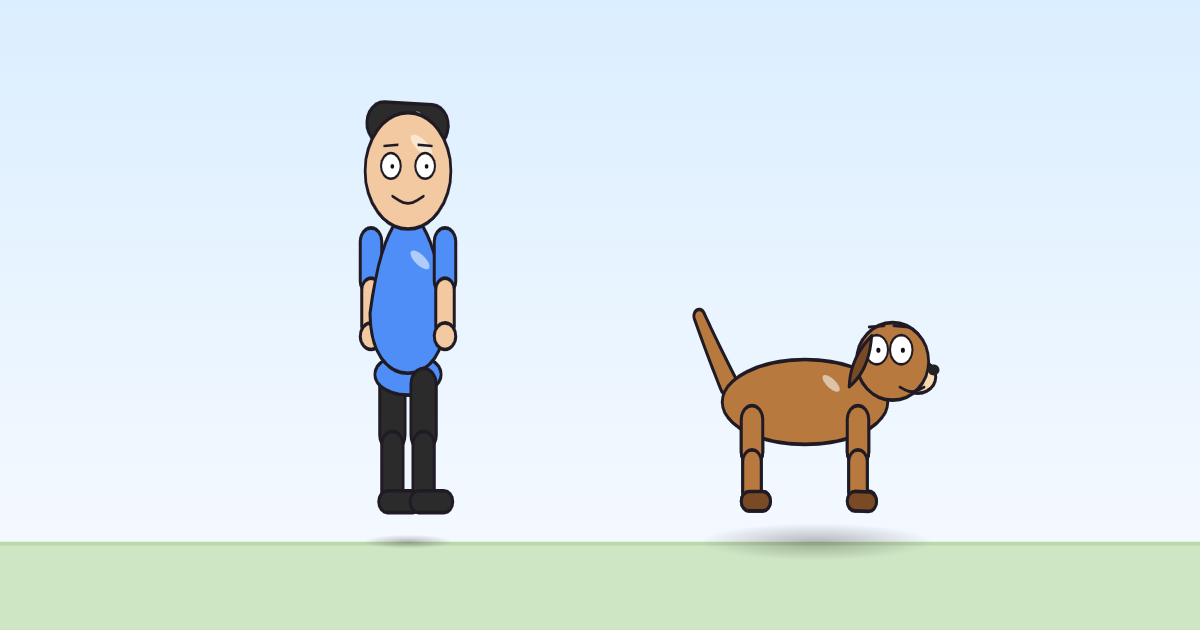
A happy hop on the spot where everything soft keeps moving: the ears, the tail, the hair and the hands lag behind the jump and flop after each landing.
Use it in a cartoonOpen it in the block editorThe pack file (JSON)
What it is for
Floppy hop is a joyful bounce for any character with soft parts: the dog's ears, the cat's tail, the kid's pigtails, the monster's antennae and tail. It is the move to show off what the skeleton adds, because the hop itself is the simple hop block and everything that makes it look alive comes from the springs. It loops for as long as the scene lasts and suits excited waiting, cheering, or a pet greeting its owner.
The principle it shows: follow-through
Soft parts do not stop when the body stops. When the body lands, the ears and the tail are still travelling, so they swing on past and settle a moment later: that is follow-through. Here each part is fixed to the body by a spring, a "let the … follow the body" block, and the spring does the work exactly, at 240 small steps a second, so the flop looks the same however fast your screen draws.
The program, line by line
when it starts
  look happy
  let the ears follow the body × 1.4
  let the tail follow the body × 1.2
  let the hair follow the body
  let the hands follow the body × 0.8
  hop 50 · every 0.7 s
when it startsandlook happy— the face changes to happy.let the ears follow the body × 1.4— the ears follow the body's bounce and tilt like springs, swinging 1.4 times as much as a plain follow would.let the tail follow the body × 1.2— the tail does the same, a little less.let the hair follow the body— the hair follows by the plain amount.let the hands follow the body × 0.8— even the hands lag a little; on a dog these are the front paws.hop 50 · every 0.7 s— the hop block, 50 pixels high, one hop every 0.7 seconds, with its crouch, stretch and landing squash.
The springs read the body's movement, so the order of these lines does not matter: every follow is worked out from the same bounce.
Try this
Hop 100 pixels high instead of 50. The springs have further to go, so the ears and tail swing much more and flop longer after every landing.
In the program:
hop · amp50→100Let the ears follow the body 3 times as much instead of 1.4. They now flap wildly with every hop, like a puppy's ears.
In the program:
letFollow · amount1.4→3
How it differs from Hop and Whip tail
Hop is the same idea without springs: a smaller, quicker hop where the ears and tail stay put. Whip tail moves the tail on purpose, with a wave travelling down it, instead of letting it follow. Floppy hop is about the parts you do not animate yourself.
Works on
| Body | Moves? | What moves |
|---|---|---|
| 2 legs (a person) | yes | whole body |
| 4 legs (a dog) | yes | whole body, tail, ears |
| no legs (the monster with no legs) | yes | whole body, tail, ears |