Fly in
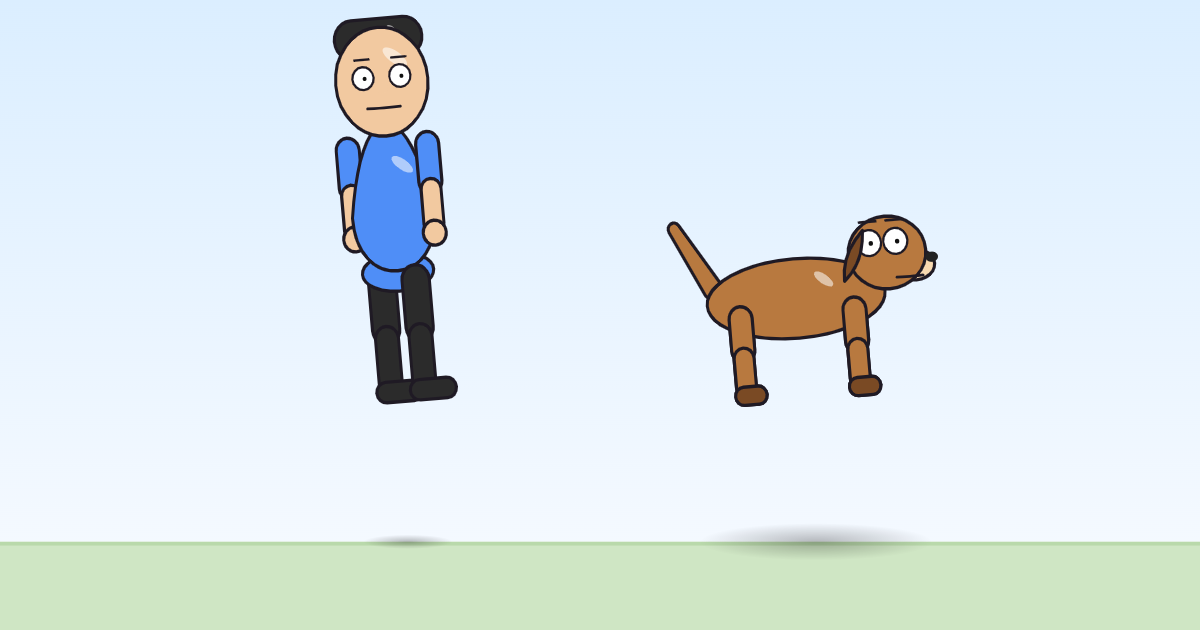
An arrival from above: the character swoops down from the upper right, rocking and fluttering, and settles onto its spot.
Use it in a cartoonOpen it in the block editorThe pack file (JSON)
What it is for
Fly in is the entrance for anything that comes from the sky: the bird, of course, but also a superhero, a falling leaf with a face, a character jumping down from a wall. It takes the whole time the move is given, so in a 3-second slot the landing comes at the very end. The rocking calms down as it nears the ground, so the landing looks controlled. There are no wing flaps in this move; the bird's wings stay folded and the flutter is in the body.
The principle it shows: slow in and slow out
The glide down uses a smooth ease, so the character speeds up out of the sky and slows down before it touches the ground: the "slow out" of a landing. The rocking is tied to the same clock and shrinks as the flight goes on, from 7 degrees to about 3, which reinforces the slowing down.
The program, line by line
settings: from_dx = 760, from_dy = -460, t_in = (dur)
when it starts
  set dx (from_dx), dy (from_dy)
  sin wave on rot · w 22 · amp (7*(1 - 0.6*smoothstep(min(tau/max(t_in, 0.1), 1)))) · on the behaviour clock
  sin wave on sy · w 22 · amp 0.05
  sin wave on sx · w 22 · amp -0.03
  glide dx 0, dy 0 over (max(t_in, 0.1)) s (smooth)
settings: from_dx = 760, from_dy = -460, t_in = (dur)— where the flight starts (760 pixels right and 460 up, negative being up) and how long it takes (dur, the whole time the move is given).set dx (from_dx), dy (from_dy)— jump to the starting point in the sky.sin wave on rot · w 22 · amp (7*(1 - 0.6*smoothstep(min(tau/max(t_in, 0.1), 1)))) · on the behaviour clock— a fast rock, about 3.5 times a second. Its size is a formula worked out on every frame:tau/t_inis how far through the flight it is (0 to 1),smoothstepeases that, and the result shrinks the rock from 7 degrees at the start to 7 × 0.4 = 2.8 degrees at the landing.sin wave on sy · w 22 · amp 0.05andsin wave on sx · w 22 · amp -0.03— the flutter: the body gets 5% taller and 3% narrower and back, in time with the rock.glide dx 0, dy 0 over (max(t_in, 0.1)) s (smooth)— the flight itself, to the character's spot, with a smooth ease.
Try this
Start 760 pixels to the left instead of the right. The character now swoops in from the upper left, which suits a scene where the action comes from that side.
In the program:
params.from_dx760→-760Make the flutter on the height 15% instead of 5%. The body pulses much more strongly as it flies, like a small bird beating hard to stay up.
In the program:
wave · amp0.05→0.15
How it differs from Fly out and Slide in
Fly out is the reverse: it rocks harder and speeds up as it leaves, to the upper left. Slide in arrives from the side at ground level, with one squish and no rocking.
Works on
| Body | Moves? | What moves |
|---|---|---|
| 2 legs (a person) | yes | whole body |
| 4 legs (a dog) | yes | whole body |
| no legs (the monster with no legs) | yes | whole body |