Hop
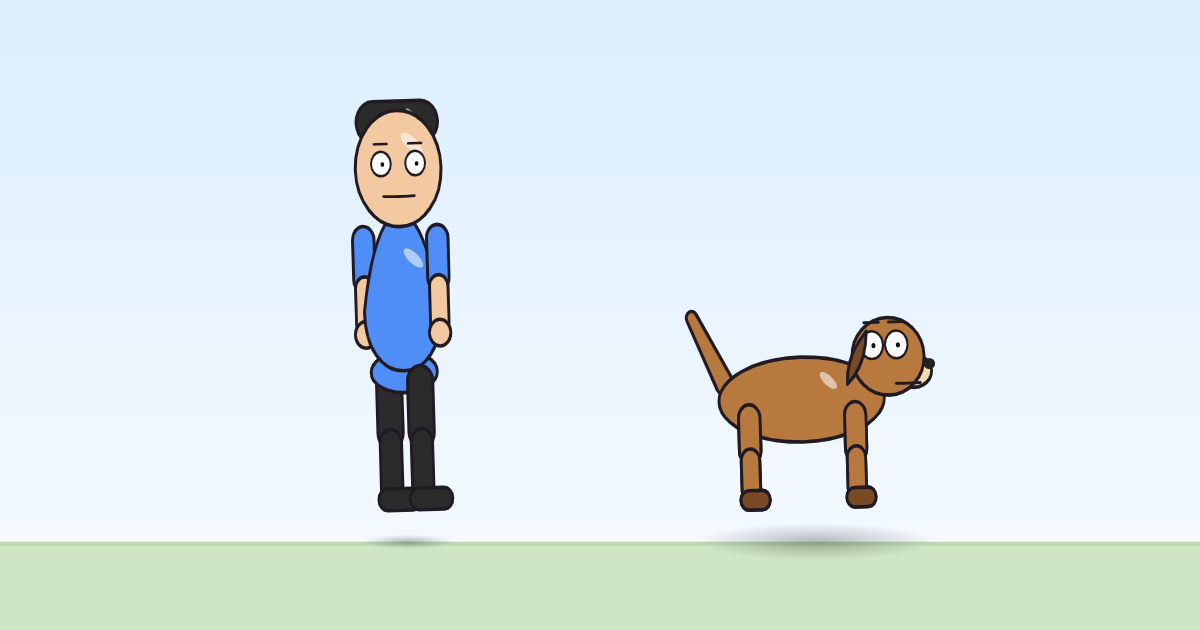
Two small hops every second with a gentle side-to-side rock. It is the quickest way to make a character look pleased.
Use it in a cartoonOpen it in the block editorThe pack file (JSON)
What it is for
Use Hop for a character who has just heard good news, or who is waiting for something nice: a present, a turn, the end of a sentence. It is small enough to run under a line of dialogue without pulling attention from the words, and quick enough that a viewer reads it as excitement rather than exercise. Because the feet leave the ground only a little, it works in a crowded scene where a big jump would hit the edge of the frame.
The principle it shows: squash and stretch
Every hop starts with a short crouch, where the body gets about 8% wider and shorter, then stretches tall as it leaves the ground and squashes again as it lands. Real bodies do not change shape like this, but cartoon audiences read the squash as weight and the stretch as speed. The volume stays roughly the same, so the character still feels solid.
The program, line by line
when it starts
  hop 54 · 2 per second
  sin wave on rot · w (1.1*pi) · amp 4
when it starts— the script begins as soon as the move is put on a character.hop 54 · 2 per second— the hop block: up to 54 pixels high (at full-HD size), twice a second. The block carries the crouch, the stretch and the landing squash by itself.sin wave on rot · w (1.1*pi) · amp 4— a smooth rock of the whole body, 4 degrees each way.wis the speed in radians per second; 1.1 × π is about 3.5, so one full rock takes about 1.8 seconds, slower than the hops and out of step with them, which keeps the movement from looking mechanical.
Try this
Make the hop more than twice as high. With 120 instead of 54 the character spends longer in the air and the squash on landing reads as a real thump, which suits a big celebration better than a small smile.
In the program:
hop · amp54→120Turn the rock up from 4 degrees to 12. The character now tips well over to each side while it hops, so the happiness looks giddy, almost out of control.
In the program:
wave · amp4→12
How it differs from Bounce and Jump for joy
Hop is the small one. Bounce jumps almost twice as high, a little slower, and throws the arms out at the top of every jump. Jump for joy is one big leap at a time with a crouch before it, arms flung straight up and a pause between leaps. Pick Hop when the feeling is light, Bounce when it is loud, and Jump for joy when it is the best moment of the day.
Works on
| Body | Moves? | What moves |
|---|---|---|
| 2 legs (a person) | yes | whole body |
| 4 legs (a dog) | yes | whole body |
| no legs (the monster with no legs) | yes | whole body |