Jump (bird, in place)
The jump of the game cycles for birds, in the same named phases the upright jump uses, so a game can start it at any point or hold the bird at the top or in the fall.
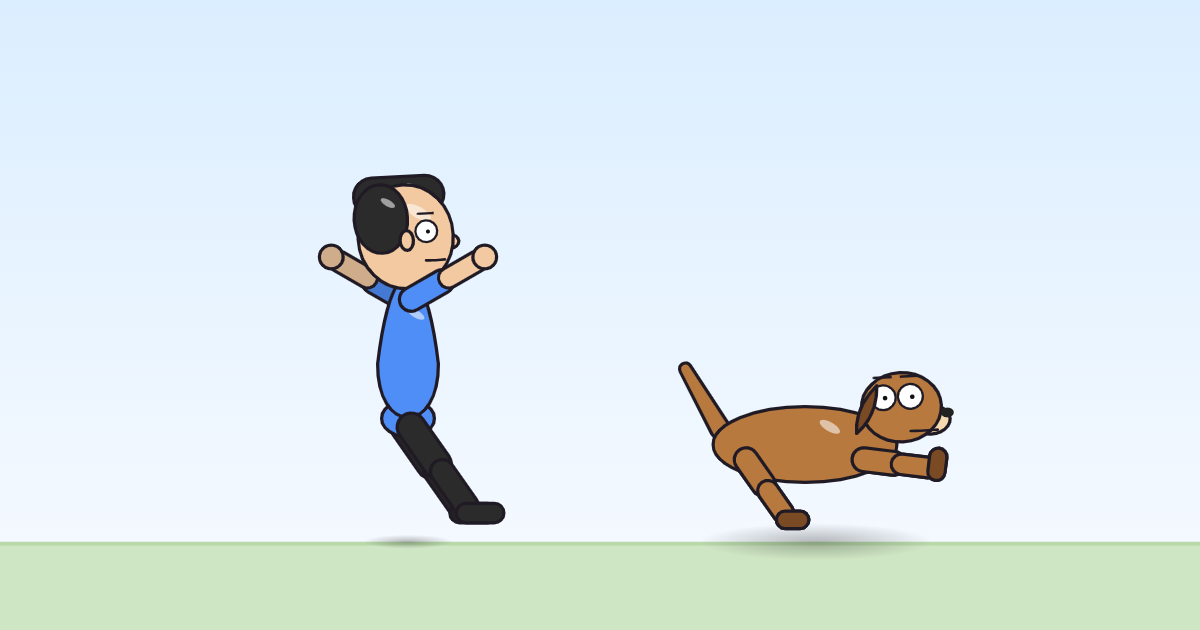
Use it in a cartoonOpen it in the block editorThe pack file (JSON)
What it is for
Jump (bird, in place) is the jump of the nine game cycles, written for the bird set: the same named phases (crouch, rise, apex, fall, land, recover) as Jump (in place), so a game can start from any one of them with the from setting, or hold the bird at the top or in the fall with hold. Because a bird's leg is one bone, the crouch bends the leg and the foot rather than a thigh and a shin, and the "arms" here are the wings, spread and beaten instead of thrown up.
The principle it shows: anticipation
Before the bird leaves the ground, it crouches, the legs bending and the wings swept back rather than out, storing the energy the spring then releases. The beat of the wings right at the spring and the flapping through the fall are what make this jump read as a bird's rather than a person's jump reused on a different body; both of those details come after the same anticipating crouch every jump in this set opens with.
The program, line by line
settings: h = 540, leg = 0.05, hold = 0, from = 0
when it starts
  show the side view
  if (from <= 0):
    at the same time:
      — 1:
        glide left leg 30, right leg 30, left foot -30, right foot -30, left arm -100, right arm 100, torso -8, head 6 over 0.14 s (out)
      — 2:
        set dx 0, dy 0
        for 0.14 s:
          dy follows (h*leg*(1 - cos(((0 + 30*sin((min(local/0.14, 1))*pi/2)))*pi/180)))
          dx follows (-h*leg*sin(((0 + 30*sin((min(local/0.14, 1))*pi/2)))*pi/180))
    set dx (-h*leg*sin((30)*pi/180)), dy (h*leg*(1 - cos((30)*pi/180)))
  if (from <= 1):
    at the same time:
      — 1:
        glide left leg 0, right leg 0, left foot 0, right foot 0, left arm 10, right arm -10, sx 0.97, sy 1.03 over 0.08 s (in)
      — 2:
        set dx 0, dy 0
        for 0.08 s:
          dy follows (h*leg*(1 - cos(((30 + -30*pow(min(local/0.08, 1), 2)))*pi/180)))
          dx follows (-h*leg*sin(((30 + -30*pow(min(local/0.08, 1), 2)))*pi/180))
    set dx (-h*leg*sin((0)*pi/180)), dy (h*leg*(1 - cos((0)*pi/180)))
    glide left leg 30, right leg 30, left foot -30, right foot -30, left arm -140, right arm 140, torso 0, sx 1, sy 1 over 0.12 s (out)
  if (from <= 2):
    glide left leg 40, right leg 40, left foot -40, right foot -40, left arm -100, right arm 100, head 0 over 0.18 s (smooth)
  if (hold == 1):
    sin wave on left arm · every 0.5 s · amp -8
    sin wave on right arm · every 0.5 s · amp 8
  else:
    if (from <= 3):
      glide left leg 14, right leg 14, left foot -14, right foot -14, left arm -120, right arm 120 over 0.22 s (in)
    if (hold == 2):
      sin wave on left arm · every 0.25 s · amp -30
      sin wave on right arm · every 0.25 s · amp 30
    else:
      glide left leg 0, right leg 0, left foot 0, right foot 0, left arm -70, right arm 70 over 0.06 s (in)
      at the same time:
        — 1:
          glide left leg 26, right leg 26, left foot -26, right foot -26, left arm -60, right arm 60, torso -6, sx 1.03, sy 0.97 over 0.12 s (out)
        — 2:
          set dx 0, dy 0
          for 0.12 s:
            dy follows (h*leg*(1 - cos(((0 + 26*sin((min(local/0.12, 1))*pi/2)))*pi/180)))
            dx follows (-h*leg*sin(((0 + 26*sin((min(local/0.12, 1))*pi/2)))*pi/180))
      set dx (-h*leg*sin((26)*pi/180)), dy (h*leg*(1 - cos((26)*pi/180)))
      at the same time:
        — 1:
          glide left leg 0, right leg 0, left foot 0, right foot 0, left arm 0, right arm 0, torso 0, head 0, sx 1, sy 1 over 0.16 s (smooth)
        — 2:
          set dx 0, dy 0
          for 0.16 s:
            dy follows (h*leg*(1 - cos(((26 + -26*smoothstep(min(local/0.16, 1))))*pi/180)))
            dx follows (-h*leg*sin(((26 + -26*smoothstep(min(local/0.16, 1))))*pi/180))
      set dx (-h*leg*sin((0)*pi/180)), dy (h*leg*(1 - cos((0)*pi/180)))
show the side view— the move is drawn in profile.if (from <= 0): …— the crouch: the legs bend and the wings sweep back, over 0.14 seconds, the body's own position worked out from the same angles so the feet do not slide.if (from <= 1): …— the spring: snaps back out in 0.08 seconds with a slight squash, then keeps rising with the wings swept further back, over another 0.12 seconds.if (from <= 2): …— the apex: the wings spread to their widest, over 0.18 seconds, the top of the jump.if (hold == 1): …— if a game holds here, the wings flutter gently instead of falling.if (from <= 3): …(in the else branch) — the fall: the wings pull back in and beat harder as the bird drops, over 0.22 seconds.if (hold == 2): …— if a game holds here instead, a bigger flutter plays through the fall.- the landing and recovery (the final else): a quick partial settle, then a squashed landing crouch kept planted by the same formula as the opening crouch, then an eased return to standing.
Written out in full, exactly as the engine prints them:
h*leg*(1 - cos(((0 + 30*sin((min(local/0.14, 1))*pi/2)))*pi/180))

-h*leg*sin(((0 + 30*sin((min(local/0.14, 1))*pi/2)))*pi/180)

-h*leg*sin((30)*pi/180)

h*leg*(1 - cos((30)*pi/180))

h*leg*(1 - cos(((30 + -30*pow(min(local/0.08, 1), 2)))*pi/180))

-h*leg*sin(((30 + -30*pow(min(local/0.08, 1), 2)))*pi/180)

-h*leg*sin((0)*pi/180)

h*leg*(1 - cos((0)*pi/180))

h*leg*(1 - cos(((0 + 26*sin((min(local/0.12, 1))*pi/2)))*pi/180))

-h*leg*sin(((0 + 26*sin((min(local/0.12, 1))*pi/2)))*pi/180)

-h*leg*sin((26)*pi/180)

h*leg*(1 - cos((26)*pi/180))

h*leg*(1 - cos(((26 + -26*smoothstep(min(local/0.16, 1))))*pi/180))

-h*leg*sin(((26 + -26*smoothstep(min(local/0.16, 1))))*pi/180)
Try this
Hold the jump at the top (hold 1 instead of 0). The wings flutter gently instead of falling, so the bird hangs at the apex for as long as a game needs.
In the program:
params.hold0→1Start the jump from the landing (from 4 instead of 0). The crouch, spring, apex and fall are all skipped; only the touchdown and the stand back up play.
In the program:
params.from0→4
How it differs from Jump (in place) and Fall (bird)
Jump (in place) is the same phased jump for a two-bone leg and arms rather than wings. Fall (bird) is the open-ended loop a game switches to once the bird is actually falling, rather than this move's own fixed fall phase.
Works on
| Body | Moves? | What moves |
|---|---|---|
| 2 legs (a person) | yes | whole body, turns, body, head, arms, legs |
| 4 legs (a dog) | yes | whole body, body, head, front legs, back legs, tail, ears |
| no legs (the monster with no legs) | yes | whole body, turns, body, arms, tail, ears |