Rise up
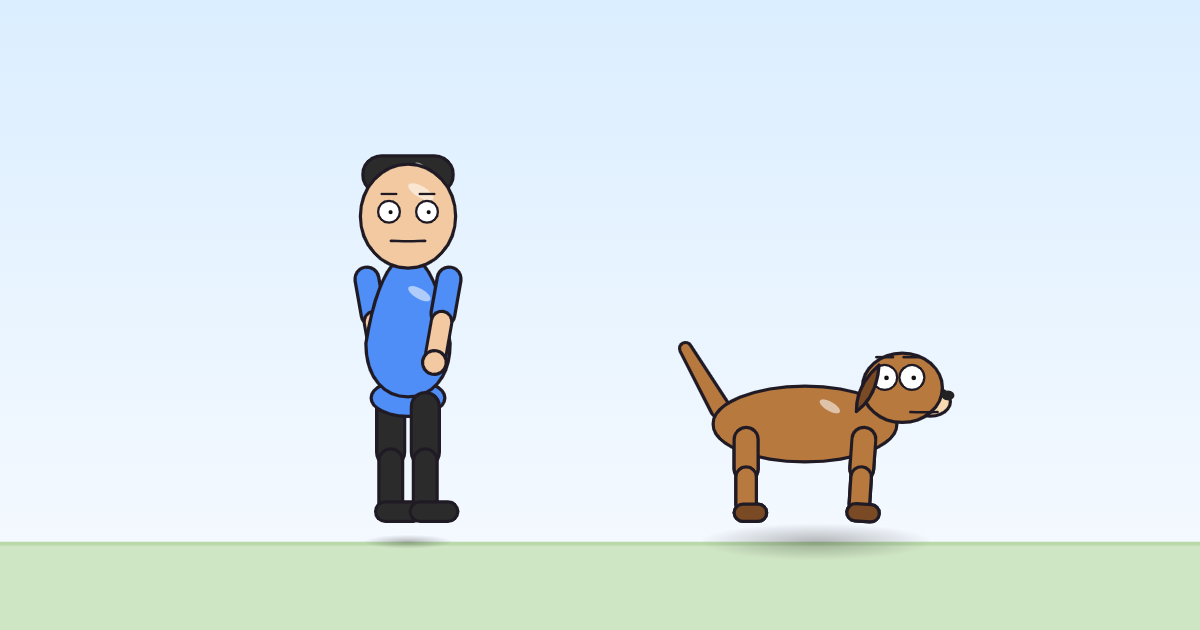
The character rises off the ground with the arms swinging in, drops back down a little bigger than before, and keeps a proud bob going.
Use it in a cartoonOpen it in the block editorThe pack file (JSON)
What it is for
Rise up is a moment of lift: a character who is announced, who wins, or who is filled with sudden confidence. The first 0.8 seconds are the event, a smooth rise; after that it settles into a proud bob that can run under a line of dialogue. Because the drop back is instant, it also makes a good comic beat: the character floats up full of itself, then lands with a bump.
The principle it shows: follow-through
When something stops suddenly, parts of it keep going for a moment. Rise up shows the simplest version: when the body lands back on the ground, a small bounce runs on after it and fades away within about a second. That fading bounce is a damped wave, the same shape as a spring settling. Without it the landing would look like a cut between two drawings.
The program, line by line
when it starts
  at the same time:
    — 1:
      glide dy -40 over 0.8 s (out)
    — 2:
      glide left arm 16, right arm -16 over 0.8 s (linear)
  set dy 0, sx 1.03, sy 1.03
  abssin wave on dy · w 2 · amp -6
  dampsin wave on dy · w 6 · amp -4 · decay 2 · clip pos
when it starts— begins when the move is put on a character.at the same time:with two branches — the first,glide dy -40 over 0.8 s (out), lifts the body 40 pixels (negative is up), fast at first and slowing at the top. The second,glide left arm 16, right arm -16 over 0.8 s (linear), turns both arms in toward the body by 16 degrees at a steady speed. The script waits until both are done.set dy 0, sx 1.03, sy 1.03— in one instant the body is back on the ground and 3% bigger in both directions.abssin wave on dy · w 2 · amp -6— a proud bob of 6 pixels, about every 1.6 seconds, from then on.dampsin wave on dy · w 6 · amp -4 · decay 2 · clip pos— the follow-through.dampsinis a wave that shrinks over time (decay 2sets how fast), andclip poskeeps only its upward half, so after the landing the body gives a few small hops of up to 4 pixels that die away.
Try this
Rise 120 pixels instead of 40. The character floats three times as high before it drops back, which makes the snap down to the ground much more noticeable.
In the program:
ramp · to.dy-40→-120Land 10% wider instead of 3%. After the rise the character comes down visibly broader than it went up, as if it had grown with pride.
In the program:
set · to.sx1.03→1.1
How it differs from Proud and Jump for joy
Proud holds a puffed stance from the start, with no rise. Jump for joy leaps much higher (150 pixels), throws the arms up instead of in, and repeats. Rise up happens once and then settles.
Works on
| Body | Moves? | What moves |
|---|---|---|
| 2 legs (a person) | yes | whole body, arms |
| 4 legs (a dog) | yes | whole body, front legs |
| no legs (the monster with no legs) | yes | whole body, arms |