Run in
A breathless entrance: the character bounds in from far off to the left, arms pumping, and keeps bouncing when it arrives.
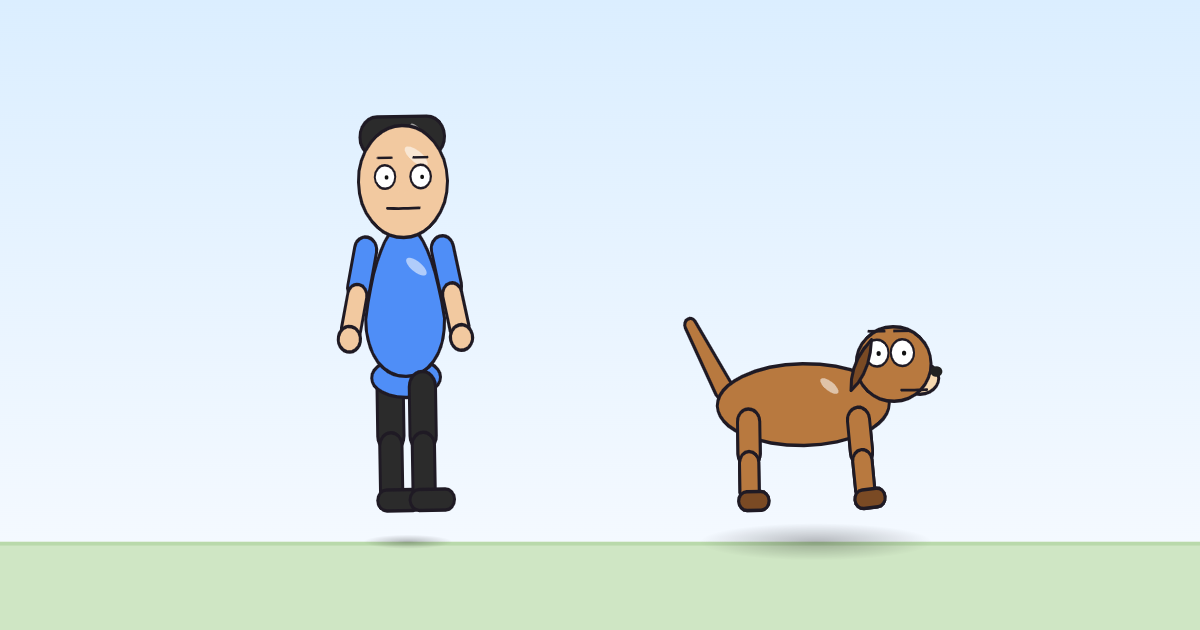
Use it in a cartoonOpen it in the block editorThe pack file (JSON)
What it is for
Run in is for a character who arrives in a hurry: late for the bus, bursting with news, chasing a ball. It starts much further away than Walk in, 1,300 pixels, so it begins well out of the frame, and reaches its spot in 2.2 seconds whatever length of time the move is given. After that it keeps hopping, which keeps the energy up for the line that follows ("Guess what!").
The principle it shows: secondary action
The main action is the travel: the body glides in at one steady speed while it hops. The arms pumping back and forth are a secondary action, smaller and faster than the hops (a full swing about every half second), that adds effort to the run. On the dog the front legs answer to the arm channel, so they paddle in the same rhythm.
The program, line by line
when it starts
  set dx -1300
  hop 80 · 1.8 per second
  sin wave on rot · w (0.9*pi) · amp 3
  sin wave on left arm · w 12 · amp 24
  sin wave on right arm · w 12 · amp -24
  glide dx 0 over 2.2 s (linear)
when it starts— begins when the move is put on a character.set dx -1300— start 1,300 pixels to the left of the character's spot.hop 80 · 1.8 per second— the hop block: 80 pixels high, 1.8 times a second, with its own squash and stretch. It keeps going after the arrival.sin wave on rot · w (0.9*pi) · amp 3— a slow rock of 3 degrees; 0.9 × π radians per second is one rock every 2.2 seconds.sin wave on left arm · w 12 · amp 24andsin wave on right arm · w 12 · amp -24— the arms swing 24 degrees each way, mirrored so they move in and out together, at 12 radians per second (a full swing every 0.52 seconds).glide dx 0 over 2.2 s (linear)— the travel: from −1,300 to the character's spot in 2.2 seconds, at one steady speed.
Try this
Arrive in 1 second instead of 2.2. The character covers the same 1,300 pixels in less than half the time, so it bursts into the scene.
In the program:
ramp · over2.2→1Start 1,300 pixels to the right instead of the left. The character now runs in from the other side; on a dog drawn facing right, that means it arrives tail first, so turn its facing in the studio to match.
In the program:
set · to.dx-1300→1300
How it differs from Walk in and Run off and back
Walk in walks with real steps from 760 pixels away and eases to a stop. Run off and back uses the same bounding style but goes the other way first: it leaves to the left, disappears for a moment and comes back.
Works on
| Body | Moves? | What moves |
|---|---|---|
| 2 legs (a person) | yes | whole body, arms |
| 4 legs (a dog) | yes | whole body, front legs |
| no legs (the monster with no legs) | yes | whole body, arms |