Run (many legs, in place)
The run of the game cycles for many legs: the legs blur through their two alternating sets while the claws stay held up and back, fitted to a speed setting so no planted leg ever slides.
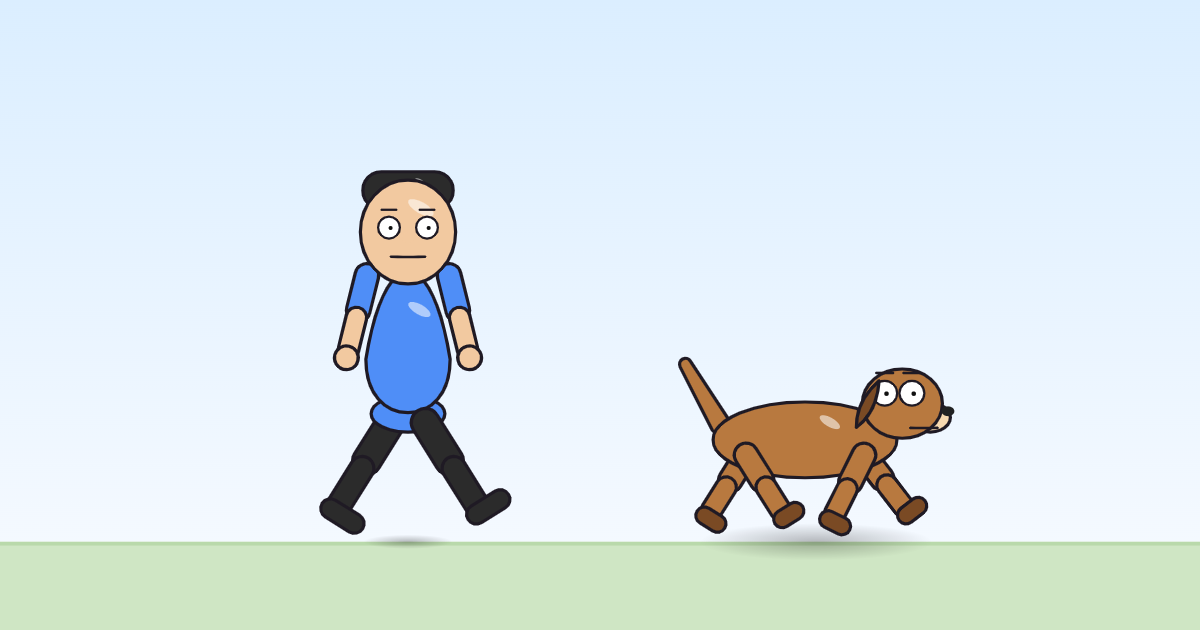
Use it in a cartoonOpen it in the block editorThe pack file (JSON)
What it is for
Run (many legs, in place) is the run of the nine game cycles, written for the many set: the legs a blur of alternating sets, the claws up and back, running sideways in place, the same two-alternating-sets gait Scuttle (many legs, in place) uses, pushed to a sprint.
The principle it shows: exaggeration
Every number here is the walk's own pushed further: a wider stride, a bigger sideways rock and a bigger rise and fall. One thing drops out rather than growing: the walk's own claw-opening wave disappears entirely, as if the claws are held fixed back out of the way while every leg's effort goes into speed instead.
The program, line by line
settings: speed = 1.5, h = 540, leg = 0.1, every = (clamp(0.3 - 0.04*speed, 0.16, 0.26)), stride = (clamp(20 + 8*speed, 24, 40))
when it starts
  set left arm -14, right arm 14, left arm lift (0.058*h), right arm lift (0.058*h)
  walk cycle every (every) s · arm swing 0 · no bob · roll 0 · stride (stride) · give 4 · bend 20
  left leg lift follows (0.04*h*max(0, -sin(2*pi*(local/(every) + 0))))
  left shin follows (20*max(0, -sin(2*pi*(local/(every) + 0))))
  right leg lift follows (0.04*h*max(0, -sin(2*pi*(local/(every) + 0.5))))
  right shin follows (20*max(0, -sin(2*pi*(local/(every) + 0.5))))
  sin wave on dx · every (every) s · amp (0.014*h)
  sin wave on rot · every (every) s · amp 4
  abssin wave on dy · every (every) s · amp (-0.012*h) · offset (-0.014*h)
set left arm -14, right arm 14, left arm lift (0.058*h), right arm lift (0.058*h)— the claws are held up and held back, out of the way of the sprint.walk cycle every (every) s · arm swing 0 · no bob · roll 0 · stride (stride) · give 4 · bend 20— the base gait: the legs stepping in their two alternating sets, timed to the stride.left leg lift follows (…),left shin follows (…),right leg lift follows (…),right shin follows (…)— a small extra lift and bend on one named leg each side, so at least one visibly clears the ground each step.sin wave on dx · every (every) s · amp (0.014*h)— the whole body rocks side to side, a little wider than the walk's own.sin wave on rot · every (every) s · amp 4— the body rolls 4 degrees, once a step.abssin wave on dy · every (every) s · amp (-0.012*h) · offset (-0.014*h)— a bigger rise and fall than the walk's, once a step.
Written out in full, exactly as the engine prints them:
clamp(0.3 - 0.04*speed, 0.16, 0.26)

clamp(20 + 8*speed, 24, 40)

0.04*h*max(0, -sin(2*pi*(local/(every) + 0)))

20*max(0, -sin(2*pi*(local/(every) + 0)))

0.04*h*max(0, -sin(2*pi*(local/(every) + 0.5)))

20*max(0, -sin(2*pi*(local/(every) + 0.5)))
Try this
Raise the running speed from 1.5 to 2 body heights a second, the top of this move's fitted range. The legs' alternating sets blur even faster, without a planted leg sliding.
In the program:
params.speed1.5→2Widen the stride directly to 40 degrees instead of letting it follow from speed. Each set of legs swings noticeably further with every step.
In the program:
params.stride"=clamp(20 + 8*speed, 24, 40)"→40
How it differs from Scuttle (many legs, in place) and Run (in place)
Scuttle (many legs, in place) is the same alternating-set gait at a gentler pace, with the claws opening and closing a little, which this run holds fixed instead. Run (in place) is the two-legged version of a sprint, a single stride rather than legs by the set.
Works on
| Body | Moves? | What moves |
|---|---|---|
| 2 legs (a person) | yes | whole body, body, arms, legs |
| 4 legs (a dog) | yes | whole body, body, front legs, back legs |
| no legs (the monster with no legs) | yes | whole body, body, arms |