Swim (many legs)
The swim of the game cycles for many legs: the legs paddle in turn, two groups opposite each other, with the claws held forward, looping every 0.8 seconds for as long as a game has the character afloat.
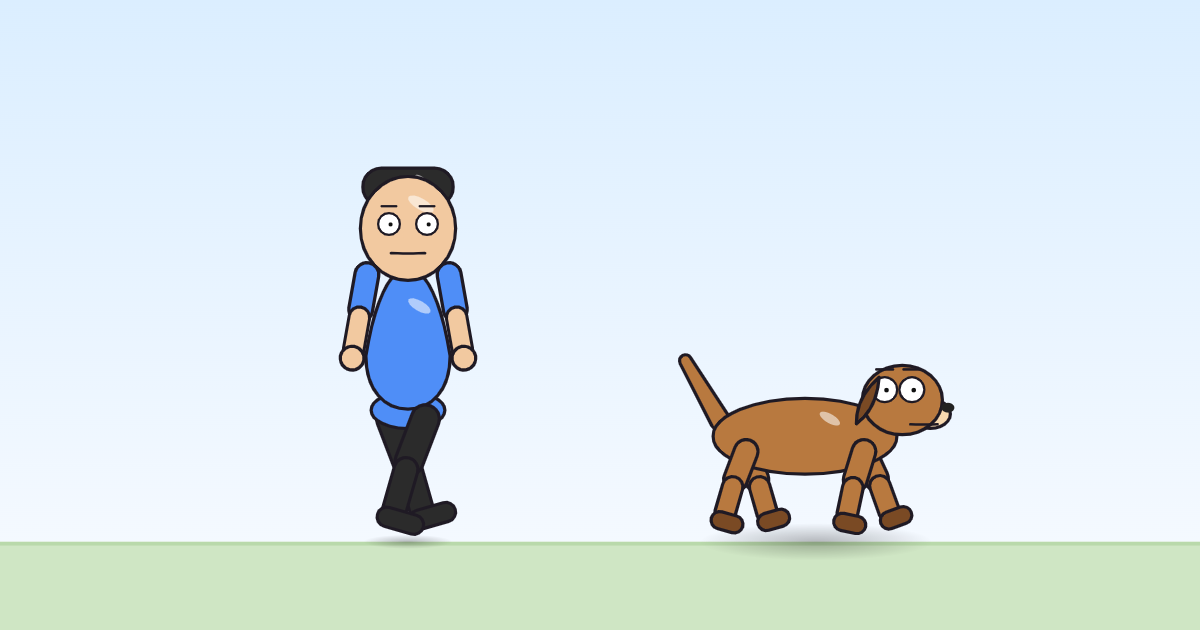
Use it in a cartoonOpen it in the block editorThe pack file (JSON)
What it is for
Swim (many legs) is the swim of the nine game cycles, written for the many set: paddling the legs one after another from back to front with the claws held forward, bobbing, rather than the upright swim's two-armed stroke.
The principle it shows: overlapping action
The legs and the shins both paddle on the same 0.8-second rhythm, but the shins lag a quarter-turn behind their own leg, so each stroke bends through rather than sweeping as one stiff piece. The body's own small bob keeps that same shared rhythm underneath, rather than a faster beat layered on top the way the upright swim's legs and tail use.
The program, line by line
settings: h = 540, leg = 0.1
when it starts
  set left arm -10, right arm 10, left arm lift (0.05*h), right arm lift (0.05*h), dy (-0.03*h)
  sin wave on left leg · every 0.8 s · amp 22
  sin wave on right leg · every 0.8 s · amp 22 · phase 3.141592653589793
  sin wave on left shin · every 0.8 s · amp 16 · phase 1.5707963267948966
  sin wave on right shin · every 0.8 s · amp 16 · phase 4.71238898038469
  sin wave on dy · every 0.8 s · amp 3
set left arm -10, right arm 10, left arm lift (0.05*h), right arm lift (0.05*h), dy (-0.03*h)— the base floating pose: the claws held forward, the body lifted slightly.sin wave on left leg · every 0.8 s · amp 22,sin wave on right leg · every 0.8 s · amp 22 · phase 3.14— both legs paddle, opposite each other.sin wave on left shin · every 0.8 s · amp 16 · phase 1.57,sin wave on right shin · every 0.8 s · amp 16 · phase 4.71— both shins bend a quarter-turn behind their own leg's stroke.sin wave on dy · every 0.8 s · amp 3— a small body bob, at the legs' own rhythm.
Try this
Paddle the left leg 35 degrees instead of 22. The stroke becomes a much harder paddle, pushing far more water with each kick.
In the program:
wave · amp22→35Hold the left claw 25 degrees out instead of 10. The claws reach much further forward while afloat.
In the program:
set · to.part:arm:-1-10→-25
How it differs from Swim and Climb (many legs)
Swim is the same idea paddling with two arms on a two-legged body rather than legs by the set. Climb (many legs) is the other cycle written for this body with no foot-planting math, reaching with claws against a surface rather than paddling through water.
Works on
| Body | Moves? | What moves |
|---|---|---|
| 2 legs (a person) | yes | whole body, body, arms, legs |
| 4 legs (a dog) | yes | whole body, front legs, back legs |
| no legs (the monster with no legs) | yes | whole body, body, arms |