Walk on and off
A whole cameo in one move: waddle on, stand for a moment while you say your piece, waddle back off the way you came.
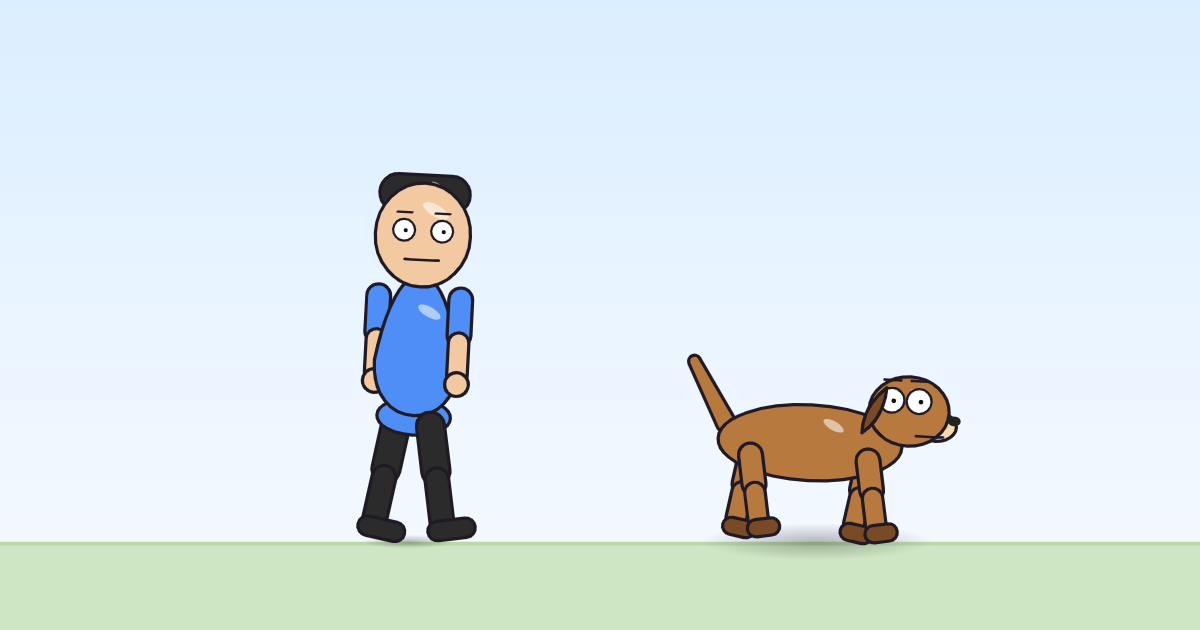
Use it in a cartoonOpen it in the block editorThe pack file (JSON)
What it is for
Walk on and off is for a character who visits a scene briefly: the postman with a parcel, a neighbour popping in to say one thing, a narrator who introduces the story and leaves. Give it the length of the visit, for example 6 seconds: it spends the first 1.5 coming on, the last 1.5 going off, and stands with a small bob in between, which is when the line should be said.
The principle it shows: staging
The move is built like a short scene: entrance, a held moment, exit. Each part has one job, and the middle part is deliberately calm, a slight lean and a gentle bob, so the audience's attention goes to what the character says rather than how it moves. Clear staging means only one thing happens at a time.
The program, line by line
settings: side = -1, t_in = 1.5, t_out = 1.5
when it starts
  set dx (860*side)
  at the same time:
    — 1:
      glide dx 0 over (max(t_in, 0.1)) s (smooth)
    — 2:
      for (t_in) s:
        sin wave on left leg · every 0.42 s · amp 10 · on the behaviour clock
        sin wave on right leg · every 0.42 s · amp -10 · on the behaviour clock
        abssin wave on dy · every 0.84 s · amp -5 · on the behaviour clock
        sin wave on rot · every 0.42 s · amp 3 · on the behaviour clock
  set rot 1.5
  until (dur - t_out) s:
    abssin wave on dy · w 1.6 · amp -4 · on the behaviour clock
  set rot 0
  at the same time:
    — 1:
      glide dx (860*side) over (max(t_out, 0.1)) s (smooth)
    — 2:
      sin wave on left leg · every 0.42 s · amp 10 · on the behaviour clock
      sin wave on right leg · every 0.42 s · amp -10 · on the behaviour clock
      abssin wave on dy · every 0.84 s · amp -5 · on the behaviour clock
      sin wave on rot · every 0.42 s · amp 3 · on the behaviour clock
settings: side = -1, t_in = 1.5, t_out = 1.5— which side to come from (−1 is the left) and how long the entrance and exit take.set dx (860*side)— start 860 pixels off to that side.at the same time:— the first branch glidesdxback to 0 overmax(t_in, 0.1)seconds with a smooth ease. The second,for (t_in) s:, swings both legs in and out together by 10 degrees, mirrored, every 0.42 seconds, bobs the body and rocks it 3 degrees: a waddle. "On the behaviour clock" keeps these waves in step from the start of the move.set rot 1.5— a small lean, held while it stands.until (dur - t_out) s:with a gentle bob — stand there, bobbing 4 pixels, until it is time to leave.duris the whole time the move is given.set rot 0, then the lastat the same time:— glide back out to860*sidepixels overmax(t_out, 0.1)seconds, with a smooth ease, while waddling.
The waddle swings the legs as plain pendulums, not with the full walk cycle, so it looks short-legged and comic. A dog drawn facing right walks on forward from the left and leaves backwards, unless the scene turns it.
Try this
Change the side from −1 to 1. The character now comes on from the right and leaves to the right, which matters when another character is already standing on the left.
In the program:
params.side-1→1Take 3 seconds to come on instead of 1.5. The entrance becomes a slow amble, and the time left for standing in the middle gets shorter to match.
In the program:
params.t_in1.5→3
How it differs from Walk in and Run off and back
Walk in arrives with a real walk cycle and stays. Run off and back does the opposite trip, leaving first and returning, at a run. Walk on and off is the only one that both arrives and leaves.
Works on
| Body | Moves? | What moves |
|---|---|---|
| 2 legs (a person) | yes | whole body, legs |
| 4 legs (a dog) | yes | whole body, front legs, back legs |
| no legs (the monster with no legs) | yes | whole body |