How game engines animate characters
Characters in video games are not drawn frame by frame. Game engines such as Unity and Godot build a character from a skeleton, store movements as data, and work out every frame as the game runs. Jabbertoon is a cartoon maker, not a game engine, but it animates characters the same way, so it is a gentle place to meet these ideas before opening a professional tool. Each idea below has its name in Unity and in Godot, and a Jabbertoon move that shows it.
The rig: a skeleton inside the character
A rig is a tree of bones with the character's art attached to them. Move a bone and everything attached to it moves too: turn the upper arm and the forearm and hand go with it. In Unity's 2D Animation package the bones live on the sprite and a Sprite Skin binds the art to them; in Godot they are a Skeleton2D node with Bone2D children. Every Jabbertoon character is a rig too: the characters page lists the bones of each one, and the creator lets you build your own.
The clip: a movement stored as data
A clip is a recorded movement that can be played on a rig. Unity calls it an Animation Clip; Godot stores an Animation in an AnimationPlayer. In Jabbertoon a clip is a move: a small block program that says how the body parts move over time, such as Wave hello. The difference is that a Jabbertoon move is a program rather than a list of keyframes, so you can read it as text and change one number.
Retargeting: one clip, many bodies
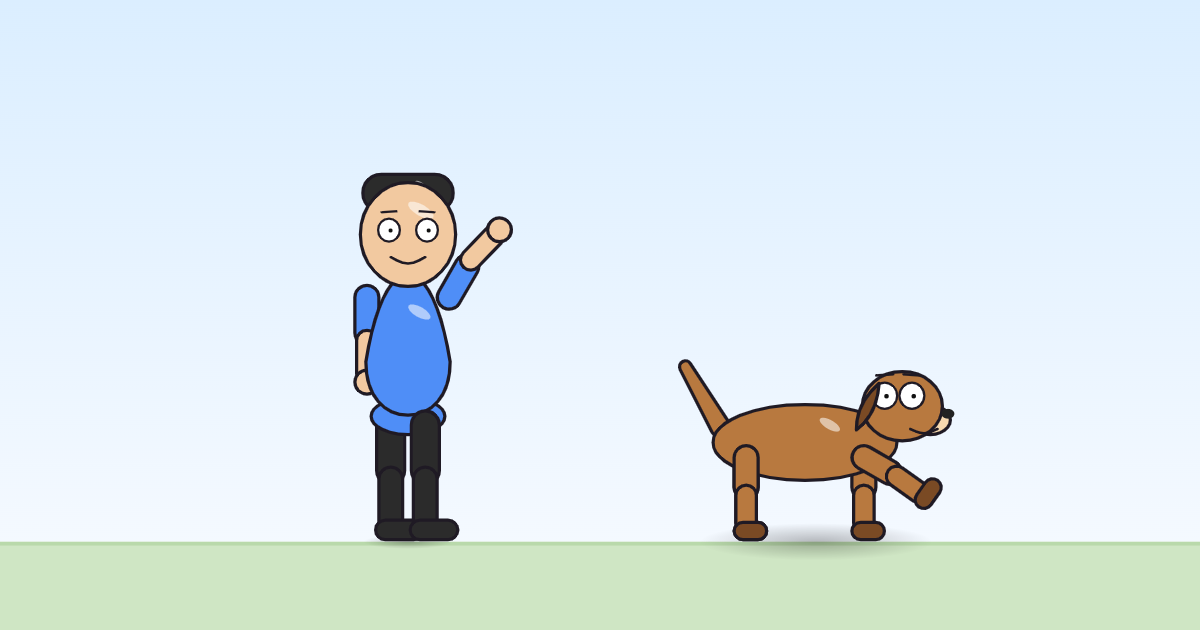
Retargeting plays a clip made for one character on another with different proportions. Unity does it for human characters through its Humanoid Avatar; Godot 4 does it for 3D skeletons with a bone map. Jabbertoon does it for every body, because a move names parts by their role (arm, leg, tail) instead of by drawing. Here is what the engine computes when Wave hello plays on each ready-made character: the person and the kid wave an arm, the dog and the cat answer the arm channel with a front leg, and the bird answers with a wing.
| Character | Moves? | What moves |
|---|---|---|
| Person | yes | whole body, arms |
| Kid | yes | whole body, arms |
| Dog | yes | whole body, front legs |
| Cat | yes | whole body, front legs |
| Bird | yes | whole body, wings |
| Monster | yes | whole body, arms |
And here is the same move playing live on all six, from one program:
Reach: inverse kinematics
Usually a pose sets each joint's angle. Inverse kinematics (IK) works the other way: you say where the hand should be, and the engine works out the angles of the shoulder and elbow to put it there. Unity's Animation Rigging package has a Two Bone IK Constraint, and its 2D IK has a Limb Solver; Godot 4 has a SkeletonModification2DTwoBoneIK. Jabbertoon's reach block is two-bone IK: in Hands on hips both hands are aimed at the hip spots, so they stay there while the body sways.
Follow-through: parts that lag behind
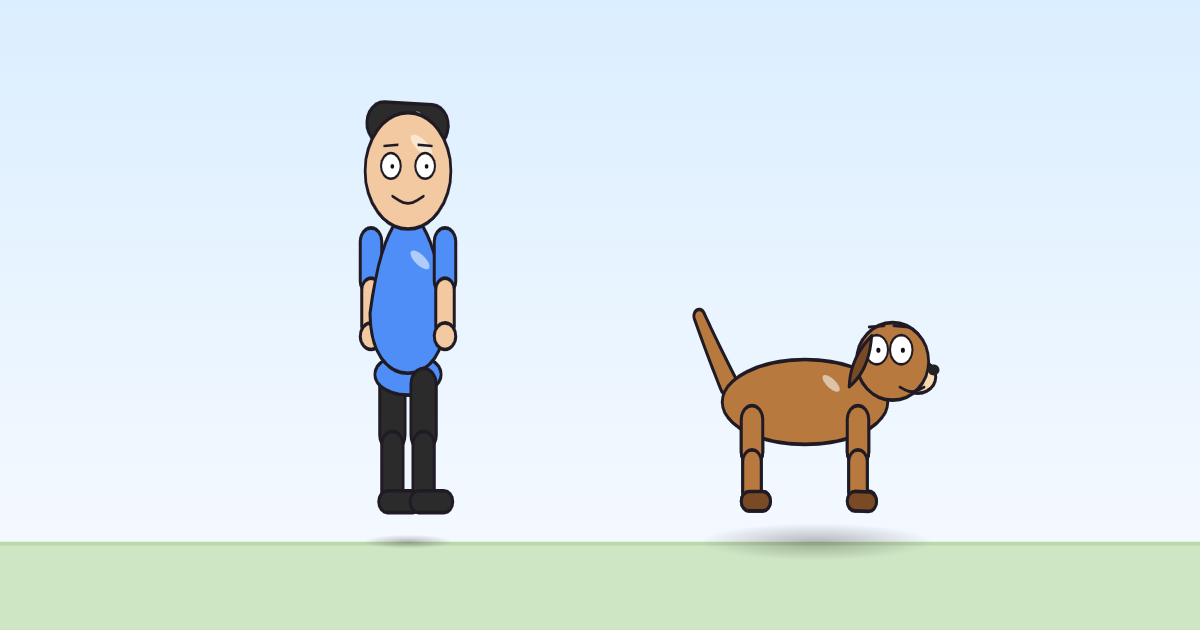
Ears, tails and hair should keep moving for a moment after the body stops. Engines simulate this with springs: Unity's Animation Rigging has a Damped Transform constraint, and Godot 4 has a SkeletonModification2DJiggle. Jabbertoon's "let the … follow" block is a damped spring too, worked out on a fixed clock so it is the same every time: in Floppy hop the ears and tail flop after every landing. Watch the dog's ears and tail:
Views and turning
A 2D character has to be drawn again to face another way. Game artists often keep separate drawings for each direction and switch between them. Jabbertoon characters have a front, a side and a back view built on the same bones, and the turn block switches between them: watch Look around.
What comes next
Game engines also give characters states (idle, walk, jump) with rules for moving between them: Unity's Animator Controller and Godot's AnimationTree state machine. Jabbertoon does not have states yet; it is a named future feature, along with responding to keys and collisions inside a cartoon. Until then, Jabbertoon is a place to learn rigs, clips, retargeting, reach and follow-through in a web browser, and the same ideas carry straight over to Unity and Godot.