Block
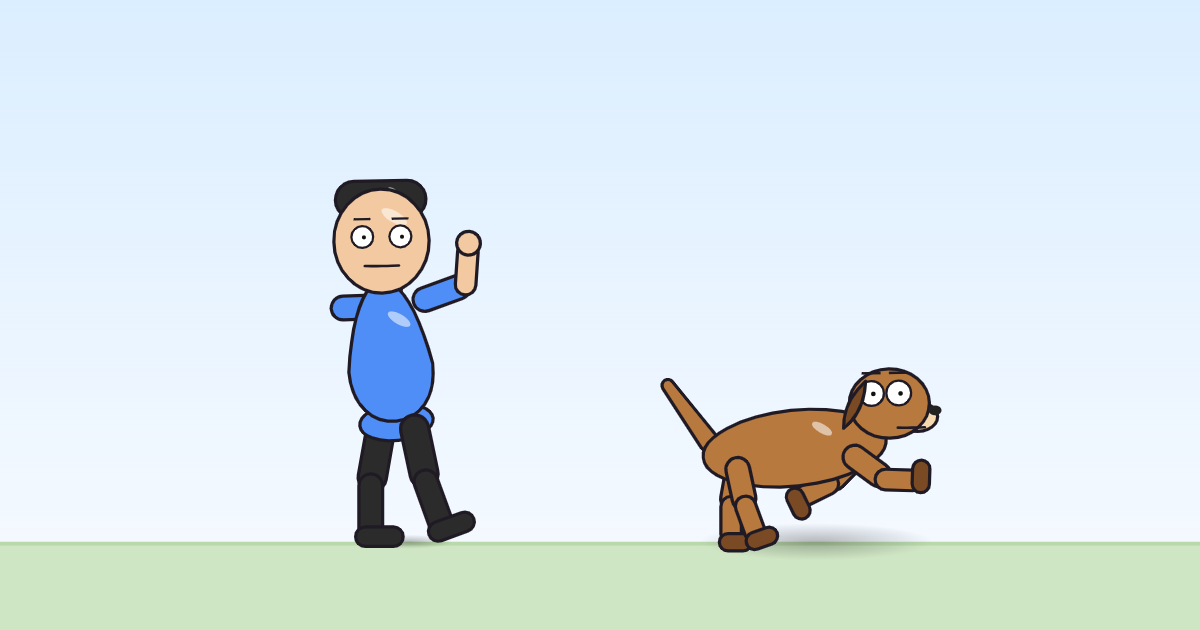
A fast, held guard: both arms snap up and the body braces back and down in 0.2 seconds, and the pose holds there — it is the one move here that does not let go by itself.
Use it in a cartoonOpen it in the block editorThe pack file (JSON)
What it is for
Block is for the instant something is about to hit a character: a snowball, a ball in a game, a shove. It snaps the whole body into a guard and holds it — there is no release ramp in the program, so once a character blocks it stays blocking until another move takes over. Its flag, Block, fires the moment the guard finishes going up, so a sound or an on-screen "blocked!" can line up with the pose rather than arrive early or late.
The principle it shows: staging
A clear pose reads in an instant, without a caption. Here every part of the guard moves at once and lands inside the same 0.2 second ramp: both arms come up and bend, unevenly, so the shape is not a stiff mirror image; the body tilts and shifts back and down a little; the legs bend into an uneven brace; the head tucks down out of the way. Nothing competes for attention and nothing arrives late — the whole body commits to one idea, defending, at the same moment.
The program, line by line
when it starts
  glide right arm 104, right forearm 66, left arm 86, left forearm 74, rot 6, dx -6, dy 5, right leg 6, right shin 8, left leg -16, left shin 10, head -5 over 0.2 s (out)
  set flag_block to (tau)
when it starts— begins the moment the move is put on a character.glide right arm 104, right forearm 66, left arm 86, left forearm 74, rot 6, dx -6, dy 5, right leg 6, right shin 8, left leg -16, left shin 10, head -5 over 0.2 s (out)— every part of the guard moves together: both arms come up and bend (unevenly, right and left), the body tilts 6 degrees and shifts back and down a little, the legs bend into an uneven brace, and the head tucks down 5 degrees.set flag_block to (tau)— the instant that glide finishes, this move marks a flag named Block at that moment (tauis the time since the move started). The flag fires once and the pose is never reset — Block is the one move in this set that holds rather than lets go.
Try this
Raise the right arm from 104 degrees to 150. The guard now covers higher, closer to the face, which reads as bracing for something coming from above rather than straight on.
In the program:
ramp · to.part:arm:1104→150Snap the whole guard up in a twentieth of a second instead of a fifth. The block now looks like a reflex, flinched up almost before the eye can follow it, rather than a deliberate stance.
In the program:
ramp · over0.2→0.05
How it differs from Duck and Ready stance
Duck also reacts fast to danger, but ducks down for well under a second and springs back up by itself; Block has no such release — it holds the guard until something else changes it. Ready stance is a calmer, open stance meant to be held between actions, without Block's raised, bracing arms.
Works on
| Body | Moves? | What moves |
|---|---|---|
| 2 legs (a person) | yes | whole body, head, arms, legs |
| 4 legs (a dog) | yes | whole body, head, front legs, back legs, ears |
| no legs (the monster with no legs) | yes | whole body, arms |