Cheer (many legs, win)
The win of the game cycles for many legs: the claws throw up high and snap open and shut, two little hops and a happy face, 1.2 seconds from start to finish, for a game to play the instant the character wins.
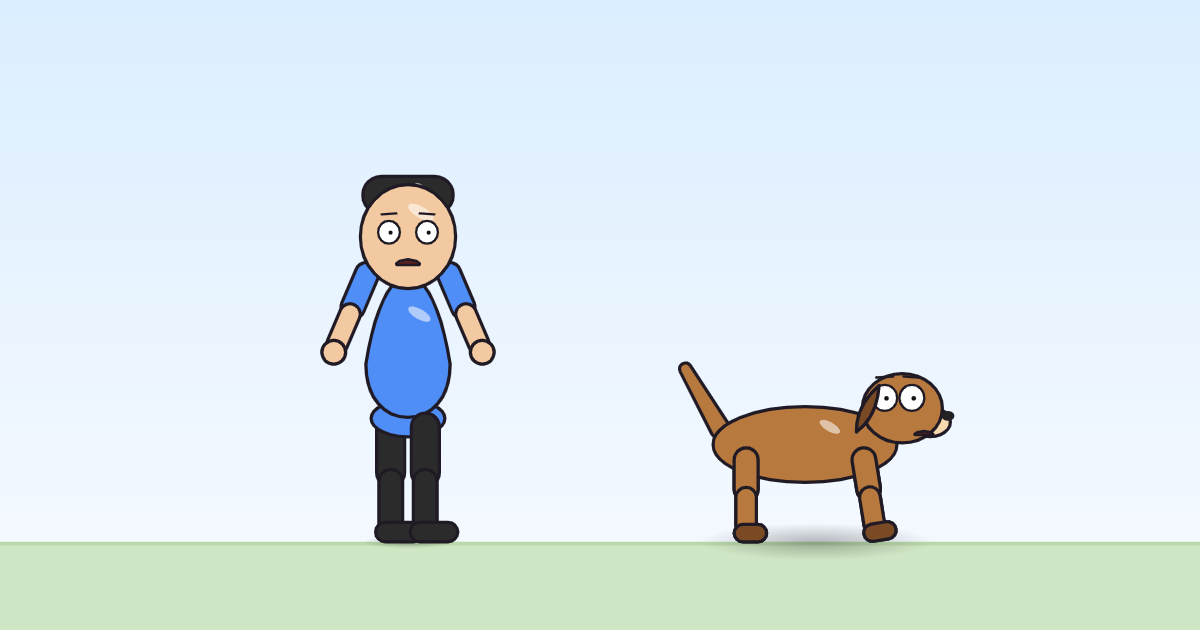
Use it in a cartoonOpen it in the block editorThe pack file (JSON)
What it is for
Cheer (many legs, win) is the win of the nine game cycles, written for the many set: the claws up high and snapping, two little hops and a happy face, the same short, 1.2-second burst as Cheer (win) but thrown with claws rather than fists.
The principle it shows: follow-through
Once the claws are thrown up, the move does not stop there: for a full 0.8 seconds the claws keep snapping open and shut while the body hops gently up and down and the arms keep swinging, all at once. That long stretch of continued motion after the main gesture is follow-through, the energy of the throw spending itself out gradually rather than cutting off.
The program, line by line
settings: h = 540, leg = 0.1
when it starts
  look happy
  glide left arm -23, right arm 23, left arm lift (0.076*h), right arm lift (0.076*h), mouth 0.5 over 0.2 s (out)
  at the same time:
    — 1:
      for 0.8 s:
        sin wave on left claw · every 0.16 s · amp 14
        sin wave on right claw · every 0.16 s · amp -14
        abssin wave on dy · every 0.8 s · amp (-0.04*h)
        sin wave on left arm · every 0.4 s · amp -8
        sin wave on right arm · every 0.4 s · amp 8
  glide left arm 0, right arm 0, left arm lift (0.03*h), right arm lift (0.03*h), mouth 0 over 0.2 s (smooth)
look happy— the face changes to its happy expression for the whole move.glide left arm -23, right arm 23, left arm lift (0.076*h), right arm lift (0.076*h), mouth 0.5 over 0.2 s (out)— both claws throw up high and apart, the mouth opening in a happy shout.at the same time:— for 0.8 seconds, both claws snap open and shut, the body hops gently up and down and both arms keep swinging, all together: the main celebration.glide left arm 0, right arm 0, left arm lift (0.03*h), right arm lift (0.03*h), mouth 0 over 0.2 s (smooth)— eases all the way back to a standing pose.
Written out in full, exactly as the engine prints them:
-0.04*hTry this
Keep the claws snapping and hopping for 1.5 seconds instead of 0.8. The celebration runs nearly twice as long before it eases off, a bigger win's reward.
In the program:
for · s0.8→1.5Open the mouth all the way (mouth 1 instead of 0.5) as the claws first go up. The cheer reads as a much bigger shout.
In the program:
ramp · to.mouth0.5→1
How it differs from Flinch (many legs, hurt) and Cheer (win)
Flinch (many legs, hurt) is the opposite reaction on the same body, claws pulling in rather than snapping up, and it is a third as long. Cheer (win) is the same idea for the upright set, two fists pumping rather than claws snapping.
Works on
| Body | Moves? | What moves |
|---|---|---|
| 2 legs (a person) | yes | whole body, body, arms |
| 4 legs (a dog) | yes | whole body, front legs |
| no legs (the monster with no legs) | yes | whole body, body, arms |