Climb
The climb of the nine game cycles: the arms reach up and pull in turn, the legs step up to match, looping every second for as long as a game has the character on a ladder or a wall.
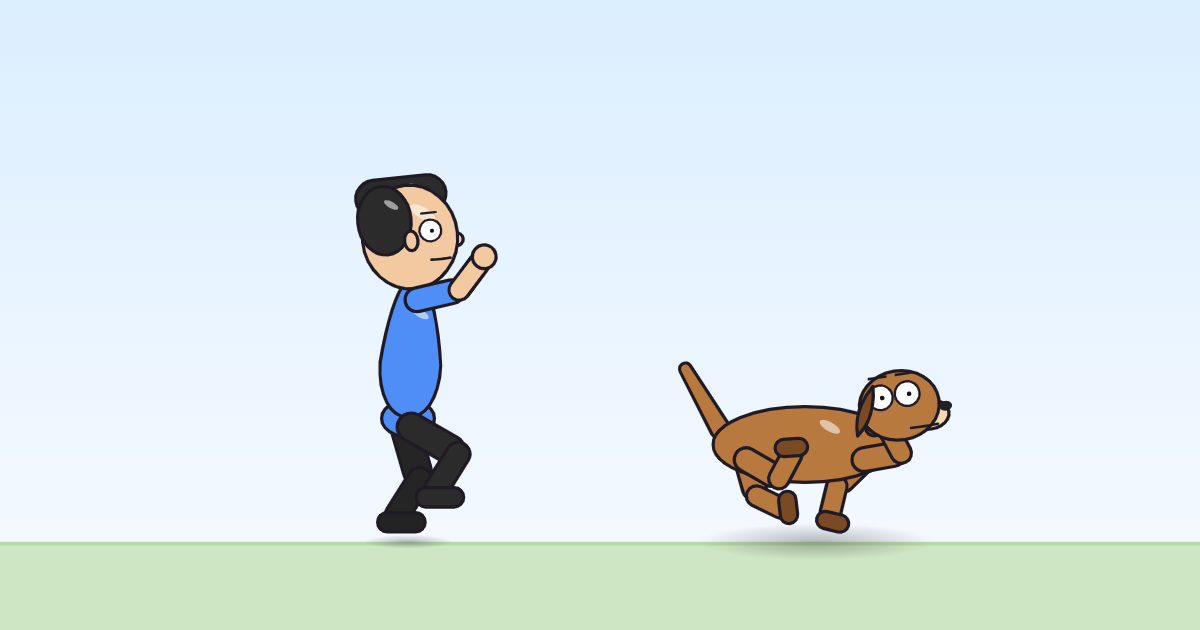
Use it in a cartoonOpen it in the block editorThe pack file (JSON)
What it is for
Climb is the climb of the nine game cycles: a game plays it while a character is on a ladder, a rope or a wall, hand over hand, looping every second for as long as the climb lasts. Unlike the walk and run, it keeps no foot-planting math at all (it never moves sideways on its own): a game is expected to decide how far up the climb actually carries the character.
The principle it shows: secondary action
The main action is the arms, each reaching up and pulling in turn, a full cycle every second. Riding on top of that is a small body bob, dy, waving every half second, twice as often as the arms: once for every single reach rather than once for every full pair of reaches. That bob is a secondary action, small and not the thing the eye follows first, but it is what sells the climb as an effortful pull rather than the arms simply waving in the air.
The program, line by line
settings: h = 540, leg = 0.24
when it starts
  show the side view
  set left arm 130, right arm 130, left forearm 40, right forearm 40, left leg 38, right leg 38, left shin 70, right shin 70, left foot 32, right foot 32, torso -3, head 9
  sin wave on left arm · every 1 s · amp 24
  sin wave on right arm · every 1 s · amp 24 · phase 3.141592653589793
  sin wave on left forearm · every 1 s · amp 26 · phase 1.5707963267948966
  sin wave on right forearm · every 1 s · amp 26 · phase 4.71238898038469
  sin wave on left leg · every 1 s · amp 22 · phase 3.141592653589793
  sin wave on right leg · every 1 s · amp 22
  sin wave on left shin · every 1 s · amp 22 · phase 3.141592653589793
  sin wave on right shin · every 1 s · amp 22
  sin wave on dy · every 0.5 s · amp -3
show the side view— the move is drawn in profile.set left arm 130, right arm 130, left forearm 40, right forearm 40, left leg 38, right leg 38, left shin 70, right shin 70, left foot 32, right foot 32, torso -3, head 9— the base climbing pose: both arms reached up, the legs bent and stepped up, the body leaned in a little toward the wall.sin wave on left arm · every 1 s · amp 24,sin wave on right arm · every 1 s · amp 24 · phase 3.14— both arms reach further and pull back in turn, opposite each other.sin wave on left forearm · every 1 s · amp 26 · phase 1.57,sin wave on right forearm · every 1 s · amp 26 · phase 4.71— both forearms bend in a quarter-turn behind their own arm's reach, the grip tightening as the arm pulls.sin wave on left leg · every 1 s · amp 22 · phase 3.14,sin wave on right leg · every 1 s · amp 22— both legs step up in turn, opposite each other.sin wave on left shin · every 1 s · amp 22 · phase 3.14,sin wave on right shin · every 1 s · amp 22— both shins bend to match their own leg's step.sin wave on dy · every 0.5 s · amp -3— a small upward bob twice as fast as the arms, once for every single reach.
Try this
Bob 8 pixels with each reach instead of 3. The climb reads as a much harder pull on every handhold.
In the program:
wave · amp-3→-8Bend the left forearm 45 degrees with each reach instead of 26. That arm stretches noticeably further toward each handhold than the right one does.
In the program:
wave · amp26→45
How it differs from Swim and Walk (in place)
Swim is the other cycle with no foot-planting math at all, but it paddles the arms in the water rather than pulling against a surface. Walk (in place) keeps the feet planted with a cosine formula the whole time it loops; Climb has no floor to plant against, so it never needs that mechanism at all.
Works on
| Body | Moves? | What moves |
|---|---|---|
| 2 legs (a person) | yes | whole body, turns, body, head, arms, legs |
| 4 legs (a dog) | yes | whole body, head, front legs, back legs, ears |
| no legs (the monster with no legs) | yes | whole body, turns, body, arms, tail, ears |