Flap wings
Both wings sweep up in 0.2 seconds, lifting the body a little, then settle back down over a slower stretch — one steady, repeating beat.
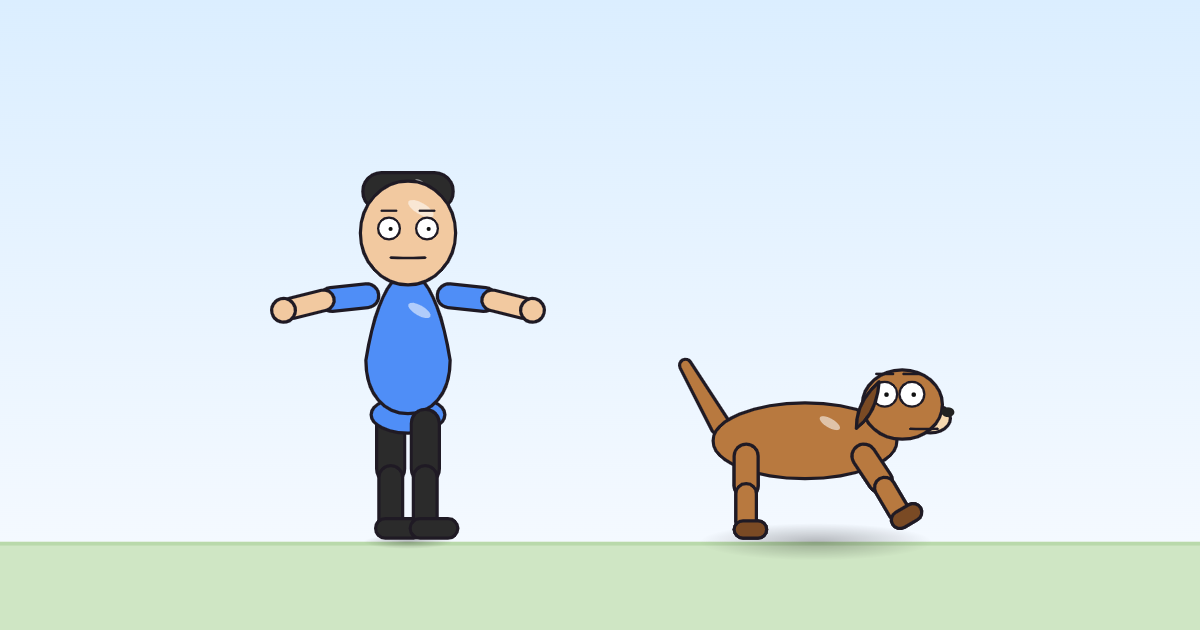
Use it in a cartoonOpen it in the block editorThe pack file (JSON)
What it is for
Flap wings is a steady, repeating wingbeat for a bird in flight or hovering in place, on the beat of the music under it, looping for as long as the move plays.
The principle it shows: timing
The two halves of each beat take different lengths of time: the upstroke — both wings sweeping up, the whole body lifting a little — takes 0.2 seconds easing out, and the downstroke takes a slower 0.3 seconds easing in. A faster push up and a slower settle down is what makes a wingbeat read as flight instead of a mechanical flap at one even speed.
The program, line by line
when it starts
  forever:
    glide right arm 84, left arm -84, right forearm -8, left forearm 8, dy -6 over 0.2 s (out)
    glide right arm 10, left arm -10, right forearm 0, left forearm 0, dy 0 over 0.3 s (in)
when it starts— begins when the move is put on a character.forever:— the wingbeat repeats for as long as the move plays.glide right arm 84, left arm -84, right forearm -8, left forearm 8, dy -6 over 0.2 s (out)— both wings sweep up and the body lifts a little, easing out.glide right arm 10, left arm -10, right forearm 0, left forearm 0, dy 0 over 0.3 s (in)— both wings sweep back down and the body settles, over a slower three tenths of a second, easing in.
Try this
Sweep the wings up in less than a tenth of a second instead of 0.2. The wingbeat becomes fast and frantic, a hummingbird's flutter instead of a steady beat.
In the program:
ramp · over0.2→0.08Sweep the right wing to 160 degrees instead of 84, almost straight up. Each beat now looks like a huge, powerful stroke rather than a modest flap.
In the program:
ramp · to.part:arm:184→160
How it differs from Head bob and Snap claws
Head bob is the other move here timed to a beat, but moves only the head; Flap wings moves both wings and lifts the whole body on every cycle. Snap claws is a quicker, single-part repeat with no lift at all.
Works on
| Body | Moves? | What moves |
|---|---|---|
| 2 legs (a person) | yes | whole body, arms |
| 4 legs (a dog) | yes | whole body, front legs |
| no legs (the monster with no legs) | yes | whole body, arms |