Flinch (four legs, hurt)
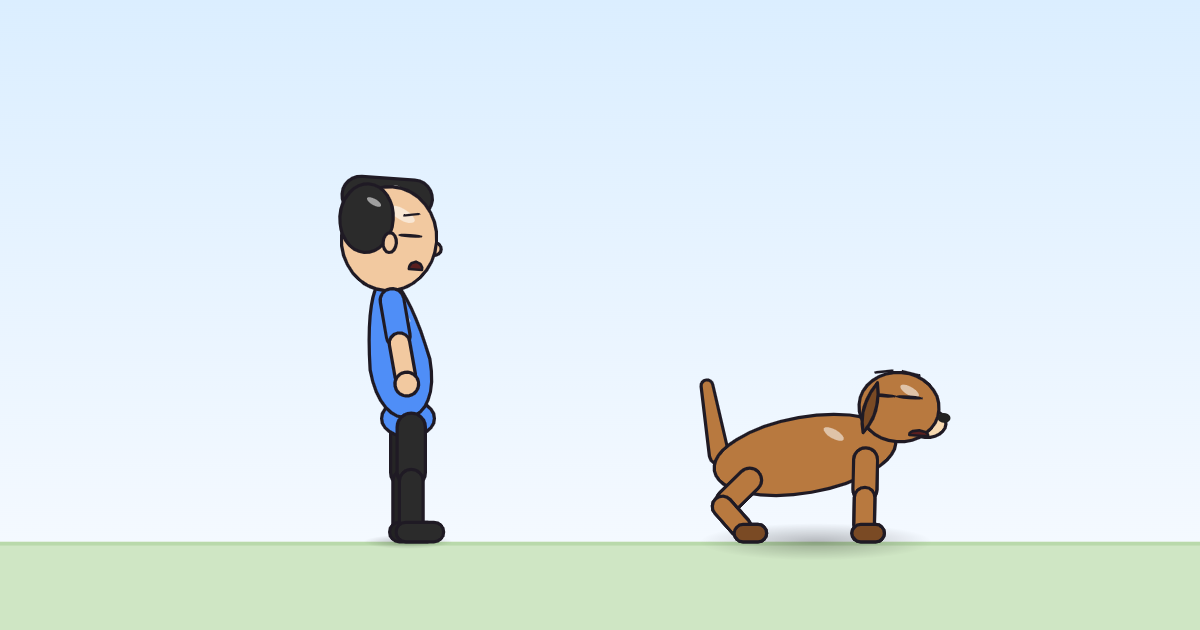
The hurt of the game cycles for four legs: the head ducks, the rear drops and the tail tucks, back to standing in 0.4 seconds, for a game to play the instant the character takes damage.
Use it in a cartoonOpen it in the block editorThe pack file (JSON)
What it is for
Flinch (four legs, hurt) is the hurt of the nine game cycles, written for the fours set: ducking the head and dropping the rear with the tail tucked, the same 0.4-second reaction as Flinch (hurt) but without bending the legs at all.
The principle it shows: slow in and slow out
The duck snaps in fast, 0.08 seconds, then eases back to normal over four times as long, 0.32 seconds, the same asymmetry every reaction in the game cycles uses. Because this one moves only the torso, head, tail and ears rather than the legs, the body's own planted position never needs correcting at all: the quick strike and the slow recovery are the whole move.
The program, line by line
settings: h = 540, leg = 0.33
when it starts
  show the side view
  look surprised
  glide torso 10, head -14, tail -30, ears 14, blink 1 over 0.08 s (out)
  glide torso 0, head 0, tail 0, ears 0, blink 0 over 0.32 s (smooth)
  look normal
show the side view— the move is drawn in profile.look surprised— the face changes to its surprised expression for the whole move.glide torso 10, head -14, tail -30, ears 14, blink 1 over 0.08 s (out)— the duck: the rear tips down, the head drops, the tail and ears pull in and the eyes shut, all in a sudden snap.glide torso 0, head 0, tail 0, ears 0, blink 0 over 0.32 s (smooth)— everything eases back to neutral, the eyes open again.look normal— the face returns to normal.
Try this
Tip the torso 20 degrees instead of 10. The rear drops much further, a far more dramatic duck.
In the program:
ramp · to.part:torso10→20Take 0.3 seconds to flinch back instead of 0.08. The recoil becomes a slow cower rather than a sudden snap.
In the program:
ramp · over0.08→0.3
How it differs from Flinch (hurt) and Cheer (four legs, win)
Flinch (hurt) is the same reaction for the upright set, bending the legs and arms where this one only tips the torso. Cheer (four legs, win) is the opposite reaction on the same body, a play bow and a bounce rather than a duck.
Works on
| Body | Moves? | What moves |
|---|---|---|
| 2 legs (a person) | yes | turns, body, head, arms |
| 4 legs (a dog) | yes | body, head, back legs, tail, ears |
| no legs (the monster with no legs) | yes | turns, body, arms, tail, ears |