Cheer (four legs, win)
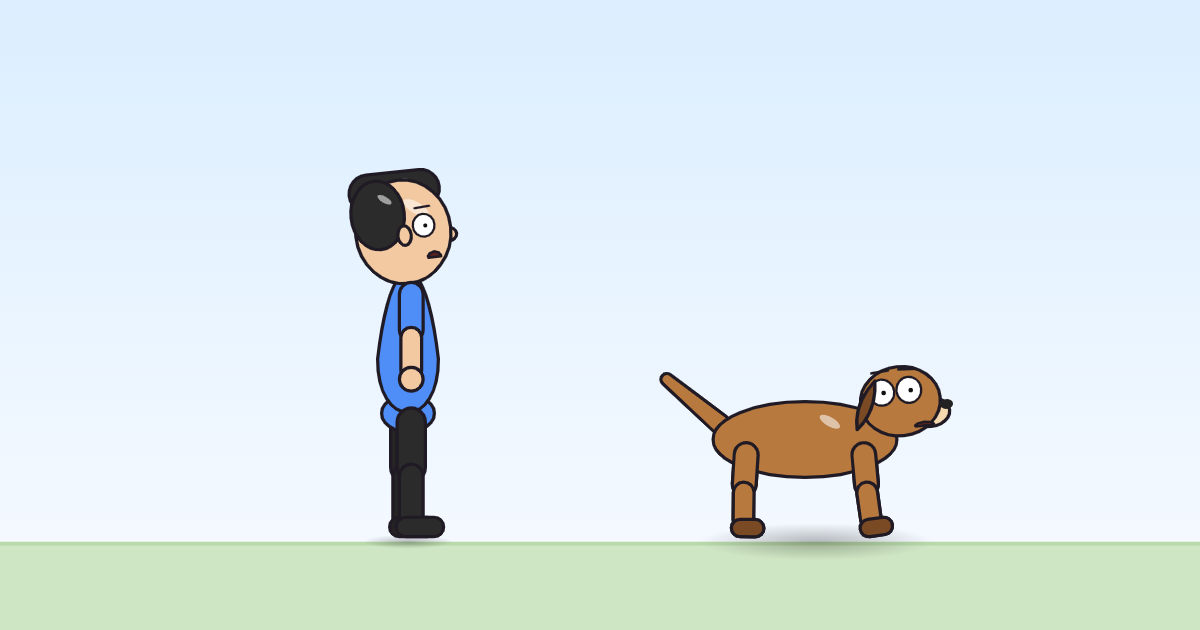
The win of the game cycles for four legs: a play bow, a little bounce and a hard tail wag with a happy face, 1.2 seconds from start to finish, for a game to play the instant the character wins.
Use it in a cartoonOpen it in the block editorThe pack file (JSON)
What it is for
Cheer (four legs, win) is the win of the nine game cycles, written for the fours set: a play bow, a bounce, a tail wagging hard and a happy face, the same short, 1.2-second burst as Cheer (win) but in a dog's or a cat's own body language rather than two fists pumping.
The principle it shows: anticipation and follow-through
The play bow, chest down and rear lifted, primes the cheer before the bounce ever happens, storing the same kind of energy a crouch does before a spring. After the main bounce, the tail does not stop wagging at once: it keeps going for 0.4 seconds, a quarter-turn out of phase with a small head bob, before easing all the way back to standing.
The program, line by line
settings: h = 540, leg = 0.33
when it starts
  show the side view
  look happy
  glide torso -16, head 10, tail 20 over 0.2 s (out)
  glide torso 0, head 6 over 0.15 s (in)
  glide dy (-0.05*h), back left leg -12, back left shin 10, back left foot 0, back right leg -12, back right shin 10, back right foot 0, front left leg 16, front left shin 10, front left foot 0, front right leg 16, front right shin 10, front right foot 0, mouth 0.5 over 0.15 s (out)
  glide dy 0, back left leg 0, back left shin 0, back left foot 0, back right leg 0, back right shin 0, back right foot 0, front left leg 0, front left shin 0, front left foot 0, front right leg 0, front right shin 0, front right foot 0 over 0.12 s (in)
  for 0.4 s:
    sin wave on tail · every 0.16 s · amp 24
    sin wave on head · every 0.2 s · amp 4
  glide head 0, tail 0, mouth 0 over 0.18 s (smooth)
show the side view— the move is drawn in profile.look happy— the face changes to its happy expression for the whole move.glide torso -16, head 10, tail 20 over 0.2 s (out)— the play bow: the chest tips down and the rear lifts, the head comes up and the tail rises.glide torso 0, head 6 over 0.15 s (in)— eases partway back up out of the bow.glide dy (-0.05*h), back left leg -12, back left shin 10, back left foot 0, back right leg -12, back right shin 10, back right foot 0, front left leg 16, front left shin 10, front left foot 0, front right leg 16, front right shin 10, front right foot 0, mouth 0.5 over 0.15 s (out)— the bounce: the body lifts and all four legs flex, the mouth opening in a happy pant.glide dy 0, legs all 0 over 0.12 s (in)— settles back down from the bounce.for 0.4 s:— the tail wags 24 degrees and the head bobs 4 degrees, a quarter-turn out of phase: the happy wag.glide head 0, tail 0, mouth 0 over 0.18 s (smooth)— eases all the way back to a standing pose.
Try this
Keep the tail wagging for 0.8 seconds instead of 0.4. The celebration runs twice as long before it eases off, a bigger win's reward.
In the program:
for · s0.4→0.8Bow the torso 30 degrees instead of 16. The play bow becomes a much deeper bow, chest nearly to the ground.
In the program:
ramp · to.part:torso-16→-30
How it differs from Flinch (four legs, hurt) and Cheer (win)
Flinch (four legs, hurt) is the opposite reaction on the same body, a duck rather than a bow, and it is a third as long. Cheer (win) is the same idea for the upright set, two fists pumping rather than a play bow and a wag.
Works on
| Body | Moves? | What moves |
|---|---|---|
| 2 legs (a person) | yes | whole body, turns, body, head, arms |
| 4 legs (a dog) | yes | whole body, body, head, front legs, back legs, tail, ears |
| no legs (the monster with no legs) | yes | whole body, turns, body, arms, tail, ears |