Hop across
Little hops that carry the character sideways across the stage, squashing on every landing, until it stops 640 pixels to the right.
Use it in a cartoonOpen it in the block editorThe pack file (JSON)
What it is for
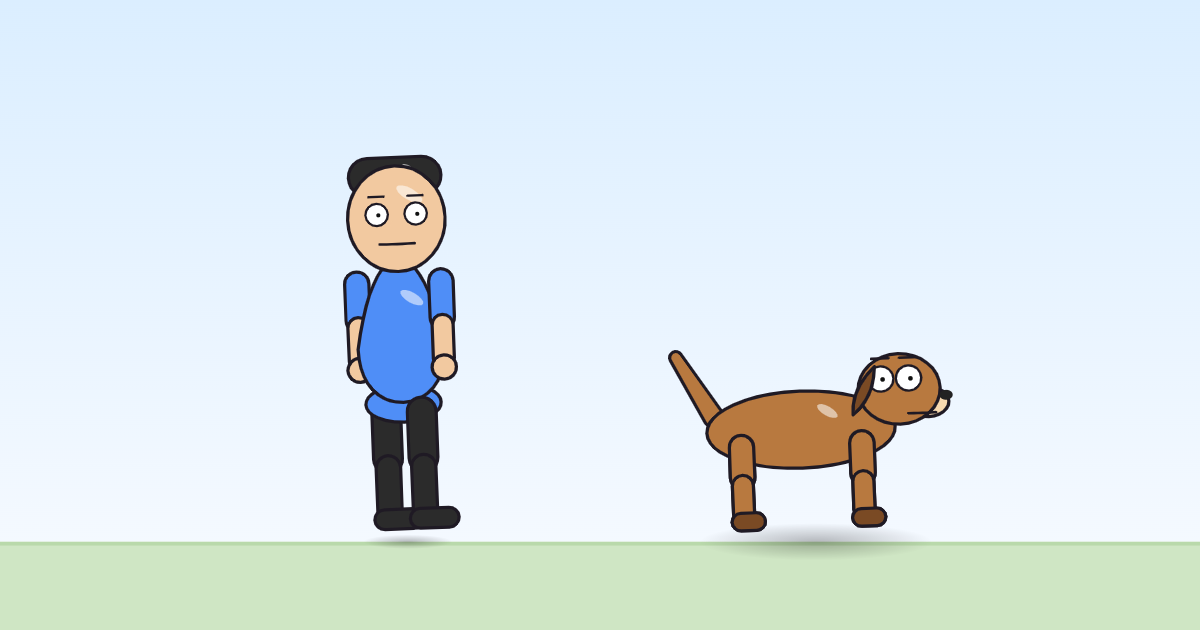
Hop across moves a character from one place to another with some bounce in it: skipping over to a friend, bounding to the window, a bird hopping along a branch. A person drawn facing you hops sideways, which looks like a playful sidestep; a dog or a cat drawn facing right hops forward. It arrives after 80% of the move's time and then keeps hopping on the spot.
The principle it shows: arcs
Two simple motions make a curved path: the body glides sideways at an even speed while a one-way wave lifts it up and down. Put together, the character traces a row of arcs across the stage, just as a bouncing ball does. Animators draw such arcs on purpose, because things in nature move along curves, and a path made of straight lines looks robotic.
The program, line by line
when it starts
  abssin wave on dy · w (2.6*pi) · amp -34
  abssin wave on sx · w (2.6*pi) · amp 0.1 · offset 0.96
  abssin wave on sy · w (2.6*pi) · amp 0.12 · offset 0.94
  sin wave on rot · w 2 · amp 4
  glide dx 640 over (max(dur*0.8, 0.1)) s (linear)
when it starts— begins when the move is put on a character.abssin wave on dy · w (2.6*pi) · amp -34— the hops: up to 34 pixels, as a one-way wave. Withw2.6 × π (about 8.2 radians per second) there is a hop every 0.38 seconds.abssin wave on sx · w (2.6*pi) · amp 0.1 · offset 0.96andabssin wave on sy · w (2.6*pi) · amp 0.12 · offset 0.94— the shape in time with the hops: on the ground the body is 4% narrower and 6% shorter than normal; at the top of a hop it is 6% wider and 6% taller than normal. Every landing is a small squash.sin wave on rot · w 2 · amp 4— a rock of 4 degrees each way, about every 3 seconds.glide dx 640 over (max(dur*0.8, 0.1)) s (linear)— the travel, 640 pixels to the right at a steady speed, over 80% of the move's time.
Try this
Hop across to the left instead of the right. The character now travels the other way, which a dog drawn facing right does tail first.
In the program:
ramp · to.dx640→-640Make the hops 80 pixels high instead of 34. The little skip becomes a big bouncy bound, more like a kangaroo than a sparrow.
In the program:
wave · amp-34→-80
How it differs from Hop and Run in
Hop stays on the spot and uses the hop block, with a crouch before each hop. Run in bounds in from far away with its arms pumping. Hop across makes its hops from simple waves and travels a medium distance, sideways if the character faces you.
Works on
| Body | Moves? | What moves |
|---|---|---|
| 2 legs (a person) | yes | whole body |
| 4 legs (a dog) | yes | whole body |
| no legs (the monster with no legs) | yes | whole body |