Sit down (four legs)
Sitting down for four legs: the rear comes down onto the folded back legs while the front stays up on straight legs, the paws staying exactly where they stood.
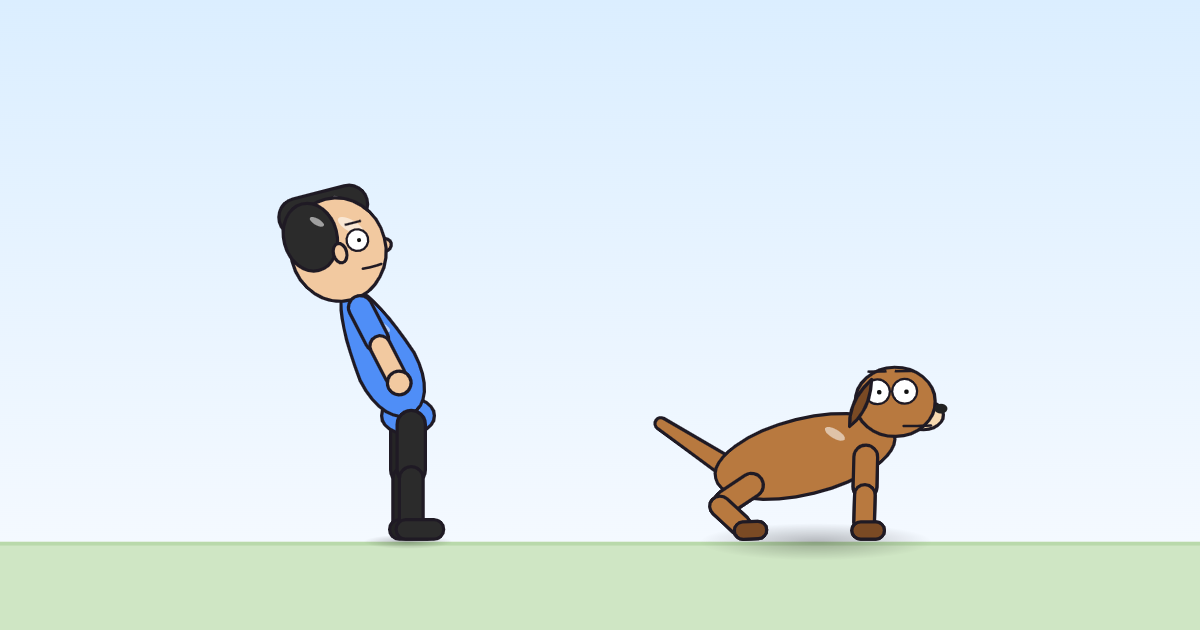
Use it in a cartoonOpen it in the block editorThe pack file (JSON)
What it is for
Sit down (four legs) is the sit-down of the nine game cycles, written for the fours set: a four-legged sit is the body turned about its standing legs, which the renderer plants, rather than a hip and a knee bending the way the upright set's sit-down does. The program itself drives only the torso, head and tail; the legs stay exactly where the renderer puts them.
The principle it shows: staging
Nothing here moves the legs at all. Tipping the torso back, dropping the head and lifting the tail is the whole motion, and that is enough: the eye reads a dog or a cat sitting down from the torso's own tilt alone, without the program needing to separately pose every joint of every leg. Staging is choosing what the audience needs to see; here, that turns out to be very little.
The program, line by line
settings: h = 540, leg = 0.33, on = 0
when it starts
  show the side view
  glide torso 34, head -16, tail 16, dy (-0.01*h) over 0.7 s (smooth)
show the side view— the move is drawn in profile.glide torso 34, head -16, tail 16, dy (-0.01*h) over 0.7 s (smooth)— the torso tips back 34 degrees, the head dips and the tail lifts, the body settling down a little, all in one eased motion.
Try this
Tip the torso 50 degrees instead of 34. The rear drops much further down, a deeper sit.
In the program:
ramp · to.part:torso34→50Take 1.2 seconds to sit instead of 0.7. The sit becomes a slow, deliberate lowering instead of a quick one.
In the program:
ramp · over0.7→1.2
How it differs from Sit down and Sit (four legs)
Sit down is the upright set's version, bending a hip and a knee the program itself drives. Sit (four legs) is the held pose this move settles into once it finishes.
Works on
| Body | Moves? | What moves |
|---|---|---|
| 2 legs (a person) | yes | whole body, turns, body, head, arms |
| 4 legs (a dog) | yes | whole body, body, head, back legs, tail, ears |
| no legs (the monster with no legs) | yes | whole body, turns, body, arms, tail, ears |