Stand and breathe
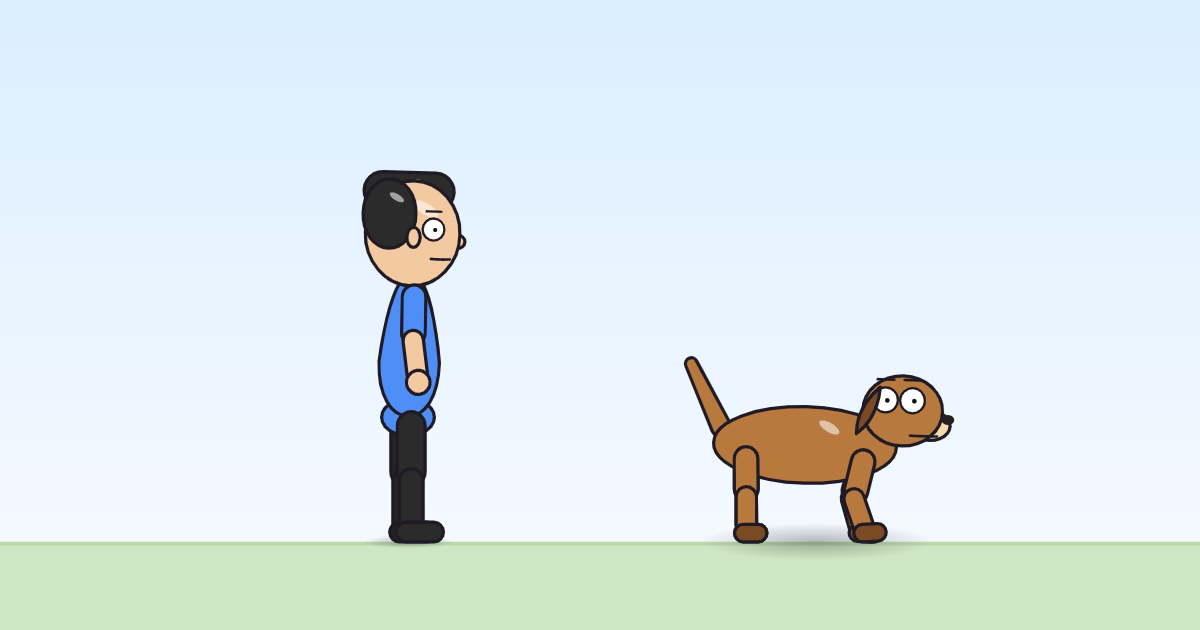
The idle of the nine game cycles: the character stands on the spot, breathing, swaying a little and blinking, for as long as a game is not walking, jumping or doing anything else with it.
Use it in a cartoonOpen it in the block editorThe pack file (JSON)
What it is for
Stand and breathe is the idle of the nine game cycles, the standard set a game plays on a character: idle, walk, run, jump, fall, hurt, win, climb and swim, plus sit. It is the pose a character holds when a game is not telling it to do anything else, so the screen never shows a frozen photograph. The hop set (the upright animal, too short-legged to stride) and the fours set (four legs) have no idle of their own and play this same pack; only the bird and the many-legged sets get their own (Stand and look about (bird) and Stand and breathe (many legs)).
The principle it shows: arcs
Nothing here is a single up-and-down wave. The body's stretch (sy, sx), its torso tip, its head tilt and each arm's sway all share the same four-second period but start at different points in it (phase 0.6, 1.4, 0.4 and 1 of the wave), so the parts settle into a loose, overlapping drift rather than moving as one rigid block, the way a real body never holds perfectly still. The tail keeps its own separate two-second sway, and the blink is not a slow wave at all: it is a sine raised to the 40th power, which squashes the curve into a short, sharp spike instead of a gentle rise and fall, so the eyes read as snapping shut rather than slowly closing.
The program, line by line
settings: h = 540, leg = 0.24
when it starts
  show the side view
  set left forearm 8, right forearm 8, torso -1
  sin wave on sy · every 4 s · amp 0.012
  sin wave on sx · every 4 s · amp -0.006
  sin wave on torso · every 4 s · amp -0.8 · phase 0.6
  sin wave on head · every 4 s · amp 1.4 · phase 1.4
  sin wave on left arm · every 4 s · amp 1.6 · phase 0.4
  sin wave on right arm · every 4 s · amp 1.6 · phase 1
  sin wave on tail · every 2 s · amp 5
  possin wave on blink · every 4 s · amp 1 · phase 1.2 · power 40
show the side view— the move is drawn in profile.set left forearm 8, right forearm 8, torso -1— a small fixed starting bend, so the arms are not hanging perfectly straight even before the sway begins.sin wave on sy · every 4 s · amp 0.012,sin wave on sx · every 4 s · amp -0.006— a slow breath: the body stretches 1.2% taller and narrows 0.6% at the same time, the opposite sign keeping the two close to one volume.sin wave on torso · every 4 s · amp -0.8 · phase 0.6— the torso tips 0.8 degrees, offset from the breath so it does not peak at exactly the same instant.sin wave on head · every 4 s · amp 1.4 · phase 1.4— the head drifts 1.4 degrees, on its own offset again.sin wave on left arm · every 4 s · amp 1.6 · phase 0.4,sin wave on right arm · every 4 s · amp 1.6 · phase 1— both arms sway 1.6 degrees, each starting at a different point in the four-second cycle.sin wave on tail · every 2 s · amp 5— the tail sways 5 degrees on its own, faster two-second rhythm.possin wave on blink · every 4 s · amp 1 · phase 1.2 · power 40— a sharp blink once every 4 seconds: the high power turns a normally smooth wave into a short spike.
Try this
Stretch the breath taller, 0.03 instead of 0.012 (a share of the character's own height). The idle now reads as a slow, deliberate sigh instead of ordinary quiet breathing.
In the program:
wave · amp0.012→0.03Blink about every 1.2 seconds instead of 4. The same calm pose now reads as nervous or twitchy, purely from how often the eyes close.
In the program:
wave · every4→1.2
How it differs from Breathe and Walk (in place)
Breathe is a hand-tuned idle for a character acting in a cartoon, built for its own timing and look. Stand and breathe is the game cycles' own default resting cycle: the same pack also stands in for the idle of the hop and fours sets, and it is built to loop forever at whatever height and leg length a game hands it. Walk (in place) is the cycle a game switches to the instant the character starts moving; Stand and breathe is what plays until then.
Works on
| Body | Moves? | What moves |
|---|---|---|
| 2 legs (a person) | yes | whole body, turns, arms |
| 4 legs (a dog) | yes | whole body, front legs, tail |
| no legs (the monster with no legs) | yes | whole body, turns, tail |