Stand up (short legs)
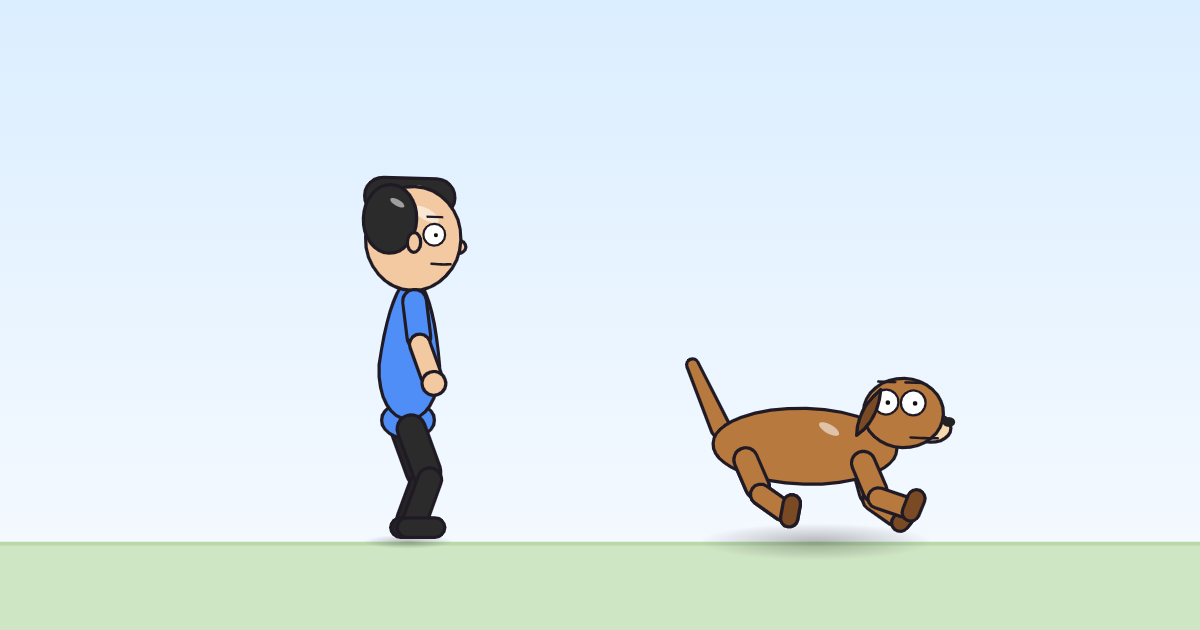
Standing up for the short-legged upright animal: the folded legs unfold back to standing, finishing with a little shake of the tail, for a game switching the character out of a sit.
Use it in a cartoonOpen it in the block editorThe pack file (JSON)
What it is for
Stand up (short legs) is the stand-up of the nine game cycles, written for the hop set: it starts from the folded pose Sit (short legs) holds and unfolds the legs back to an ordinary standing pose, ending with a small shake of the tail rather than the long-legged stand-up's lean and push.
The principle it shows: arcs
The unfolding legs are still kept planted by the same cosine geometry the sit-down and the sit use, worked out from the hip and knee angles as they straighten rather than drawn separately. The tail's own little shake, right at the very end and not tied to that geometry at all, is the one touch that marks the motion as finished.
The program, line by line
settings: h = 540, leg = 0.09, on = 0
when it starts
  show the side view
  set hips 0, left leg 46, right leg 46, left shin 92, right shin 92, left foot 46, right foot 46, dx (-h*leg/2*(sin((46)*pi/180) + sin(((46) - (92))*pi/180))), dy (h*leg/2*(2 - cos((46)*pi/180) - cos(((46) - (92))*pi/180))), tail -10, torso -4, left arm 20, right arm 20, left forearm 30, right forearm 30
  at the same time:
    — 1:
      glide hips 0, left leg 0, right leg 0, left shin 0, right shin 0, left foot 0, right foot 0, tail 0, torso 0, left arm 0, right arm 0, left forearm 0, right forearm 0 over 0.55 s (smooth)
    — 2:
      set dx 0, dy 0
      for 0.55 s:
        dy follows (h*leg/2*(2 - cos(((46 + -46*smoothstep(min(local/0.55, 1))))*pi/180) - cos((((46 + -46*smoothstep(min(local/0.55, 1)))) - ((92 + -92*smoothstep(min(local/0.55, 1)))))*pi/180)))
        dx follows (-h*leg/2*(sin(((46 + -46*smoothstep(min(local/0.55, 1))))*pi/180) + sin((((46 + -46*smoothstep(min(local/0.55, 1)))) - ((92 + -92*smoothstep(min(local/0.55, 1)))))*pi/180)))
  set dx (-h*leg/2*(sin((0)*pi/180) + sin(((0) - (0))*pi/180))), dy (h*leg/2*(2 - cos((0)*pi/180) - cos(((0) - (0))*pi/180)))
  for 0.3 s:
    sin wave on tail · every 0.15 s · amp 12
show the side view— the move is drawn in profile.set hips 0, left leg 46, right leg 46, left shin 92, right shin 92, left foot 46, right foot 46, dx …, dy …, tail -10, torso -4, left arm 20, right arm 20, left forearm 30, right forearm 30— starts from the settled, folded pose.at the same time:— the unfold: the hips, legs, shins, tail, torso and arms all ease back to neutral together, over 0.55 seconds, the body's own position kept in step with the fold so the paws stay put until the legs are straight.set dx 0, dy 0— locks the body to its ordinary standing position.for 0.3 s:— the tail shakes 12 degrees, once every 0.15 seconds, a quick little flourish right after standing.
Written out in full, exactly as the engine prints them:
-h*leg/2*(sin((46)*pi/180) + sin(((46) - (92))*pi/180))

h*leg/2*(2 - cos((46)*pi/180) - cos(((46) - (92))*pi/180))

h*leg/2*(2 - cos(((46 + -46*smoothstep(min(local/0.55, 1))))*pi/180) - cos((((46 + -46*smoothstep(min(local/0.55, 1)))) - ((92 + -92*smoothstep(min(local/0.55, 1)))))*pi/180))

-h*leg/2*(sin(((46 + -46*smoothstep(min(local/0.55, 1))))*pi/180) + sin((((46 + -46*smoothstep(min(local/0.55, 1)))) - ((92 + -92*smoothstep(min(local/0.55, 1)))))*pi/180))

-h*leg/2*(sin((0)*pi/180) + sin(((0) - (0))*pi/180))

h*leg/2*(2 - cos((0)*pi/180) - cos(((0) - (0))*pi/180))
Try this
Take a full second to unfold instead of 0.55. The stand-up becomes a slow, careful rise instead of a quick one.
In the program:
ramp · over0.55→1Keep the tail shaking for 0.6 seconds instead of 0.3. The little shake at the end lasts twice as long before it settles.
In the program:
for · s0.3→0.6
How it differs from Sit (short legs) and Stand up
Sit (short legs) is the settled pose this move rises out of. Stand up is the long-legged version of the same idea, a lean and a push rather than an unfold and a tail shake.
Works on
| Body | Moves? | What moves |
|---|---|---|
| 2 legs (a person) | yes | whole body, turns, body, head, arms, legs |
| 4 legs (a dog) | yes | whole body, body, head, front legs, back legs, tail, ears |
| no legs (the monster with no legs) | yes | whole body, turns, body, arms, tail, ears |