Stand up (four legs)
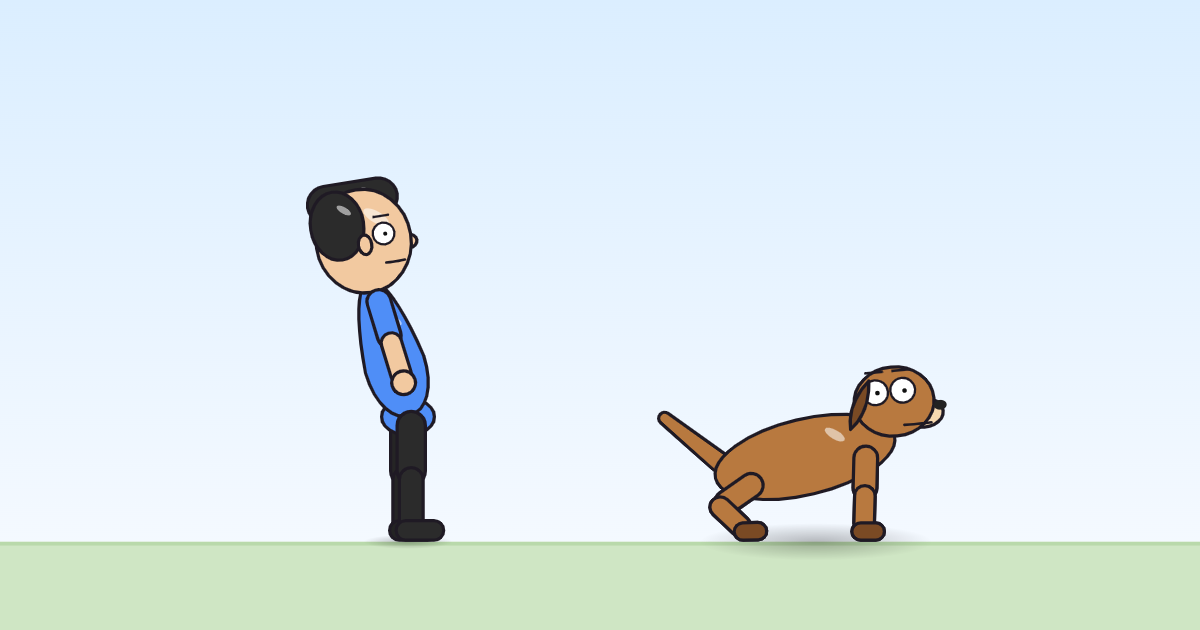
Standing up for four legs: the rear lifts back onto straight legs from sitting, for a game switching the character out of a sit.
Use it in a cartoonOpen it in the block editorThe pack file (JSON)
What it is for
Stand up (four legs) is the stand-up of the nine game cycles, written for the fours set: it starts from the pose Sit (four legs) holds and lifts the rear back up onto straight legs, the torso's own tilt doing the whole motion the way it does in Sit down (four legs).
The principle it shows: staging
As with sitting down, nothing here drives the legs directly: the torso tipping back level, the head coming up and the tail settling is the whole motion, and the renderer's own planted legs carry the rest. The eye reads a dog or a cat standing up from the torso's own unbending alone.
The program, line by line
settings: h = 540, leg = 0.33, on = 0
when it starts
  show the side view
  set torso 34, head -16, tail 16, dy (-0.01*h)
  glide torso 0, head 0, tail 0, dy 0 over 0.6 s (smooth)
show the side view— the move is drawn in profile.set torso 34, head -16, tail 16, dy (-0.01*h)— starts from the settled sitting pose.glide torso 0, head 0, tail 0, dy 0 over 0.6 s (smooth)— the torso levels back out, the head comes up and the tail settles, all in one eased motion back to standing.
Try this
Take a full second to stand instead of 0.6. The stand-up becomes a slow, careful rise instead of a quick one.
In the program:
ramp · over0.6→1Start the tail lifted 30 degrees instead of 16. The sitting pose this move rises out of looks noticeably more alert.
In the program:
set · to.part:tail16→30
How it differs from Sit (four legs) and Stand up
Sit (four legs) is the settled pose this move rises out of. Stand up is the upright set's version, bending a hip and a knee the program itself drives rather than tipping a torso.
Works on
| Body | Moves? | What moves |
|---|---|---|
| 2 legs (a person) | yes | whole body, turns, body, head, arms |
| 4 legs (a dog) | yes | whole body, body, head, back legs, tail, ears |
| no legs (the monster with no legs) | yes | whole body, turns, body, arms, tail, ears |